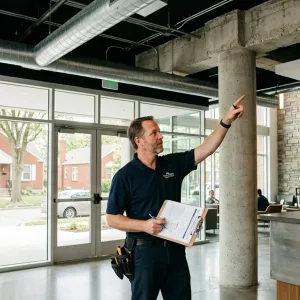
A Fort Worth investor closed on a 12,000-square-foot retail strip center last year. The deal moved fast, the price was right, and in the rush to secure the property, the commercial inspection got pushed aside. Six months later, he was staring at a $50,000 HVAC replacement bill — three rooftop units that were well past their service life, something a proper Property Condition Assessment would have flagged immediately. A DFW homebuyer had a similar story: a quick close on a home in Roanoke, no inspection contingency, and a $15,000 roof repair waiting for her on the other side of closing day.
This doesn’t have to be you. Understanding the differences between commercial and residential property inspection requirements — before you’re under contract — is one of the most powerful things you can do to protect your investment. Whether you’re buying a starter home in Weatherford, a rental property in Eagle Mountain, or a commercial building in Southlake, the rules, standards, costs, and expectations are different. And knowing those differences gives you real leverage.
This guide breaks it all down clearly, so you can walk into any real estate transaction in the DFW market with your eyes open.
Key Takeaways
- Texas requires a TREC license for residential inspectors — but not for commercial inspectors. The standards and credentials are completely different.
- Residential inspections follow TREC Standards of Practice; commercial inspections follow ASTM E2018 (Property Condition Assessment standards).
- Residential inspections typically cost $375–$700 in DFW and take 2–4 hours. Commercial inspections range from $500 to $15,000+ and can take days or weeks.
- 75–90% of residential inspections uncover at least one significant defect — making the inspection fee one of the best investments in any home purchase.
- Skipping an inspection in a competitive DFW market is a high-risk decision. Post-closing repair costs routinely dwarf the cost of the inspection itself.
- Commercial buyers need inspectors with ASTM E2018 knowledge and commercial-specific credentials — a TREC residential license alone is not sufficient.
- Inspection reports are negotiation tools. Defects discovered before closing give you leverage for price reductions, repair credits, or seller concessions.
Why Property Inspections Matter in the DFW Real Estate Market
The Dallas-Fort Worth metroplex is one of the most active real estate markets in the country — and that activity cuts both ways. On one hand, it means opportunity. On the other, it means speed, competition, and pressure that can push buyers into decisions they’ll regret. The DFW market sees more than 100,000 residential transactions annually, plus thousands of commercial deals spanning office buildings, retail centers, industrial warehouses, and multifamily properties. That volume creates enormous demand for qualified property inspection services in the DFW area — and unfortunately, it also creates conditions where buyers feel pressured to skip inspections entirely.
Fort Worth, Weatherford, Justin, and the surrounding communities are at the epicenter of North Texas growth. New subdivisions are going up seemingly overnight. Commercial corridors are expanding. And in that kind of seller’s market energy, it’s easy to feel like you’ll lose the deal if you ask for an inspection contingency. That pressure is real — but the financial risk of waiving your inspection is far greater than the risk of losing one deal.
Consider the math: a residential inspection in DFW costs $375–$700. The average cost of defects discovered post-closing — when you have no leverage and no legal recourse — ranges from $2,000 to $10,000 or more. For commercial properties, the gap is even wider. A $1,500 commercial inspection could reveal $50,000 in deferred HVAC maintenance or a roof replacement that would have wiped out your first two years of cash flow. Understanding local inspection requirements isn’t just academic — it’s the foundation of smart buying in this market.
Feeling Pressure to Skip the Inspection? You’re Not Alone.
In competitive DFW markets, sellers and agents often pressure buyers to waive inspections to close faster. This is a common tactic — and a common mistake. An inspection is your only legal protection against hidden defects. In a market moving this fast, the inspection contingency isn’t a sign of weakness — it’s a sign of experience.
Residential Property Inspections: Texas Requirements and Standards
If you’re buying a home anywhere in Texas — whether it’s a 1,200-square-foot bungalow in Roanoke or a 4,500-square-foot custom home in Trophy Club — your inspector must be licensed by the Texas Real Estate Commission (TREC). This is not optional. It’s state law. Working with TREC-licensed residential inspectors is the baseline requirement for any legitimate residential inspection in Texas, and it’s your first line of protection as a buyer.
TREC licensing isn’t just a piece of paper. It requires completion of qualifying education hours (140 hours minimum for an Apprentice Inspector, 270 hours for a Real Estate Inspector, and an additional 200 hours for a Professional Real Estate Inspector), supervised field experience, passing state-administered exams, a background check, and ongoing continuing education. Inspectors must also carry Errors and Omissions (E&O) insurance with minimums of $100,000 per occurrence and $300,000 aggregate, plus a $5,000 surety bond. These requirements exist to protect you.
TREC also establishes the Standards of Practice (SOP) that govern what a residential inspector must evaluate during every inspection. These standards define both the scope of the inspection and its limitations — so you know exactly what you’re getting when you hire a licensed inspector.
Industry data from InterNACHI and the National Association of Home Inspectors consistently shows that 75–90% of residential inspections uncover at least one significant defect. That’s not a scare statistic — it’s a reflection of how much can go wrong in a home over time, and why the inspection fee is almost always money well spent. You can read more about what a Journey Home Inspection covers to understand the full scope of a professional residential inspection.
How to Verify a Residential Inspector’s TREC License
Verifying a residential inspector’s TREC license takes about two minutes and should be a non-negotiable step before you hire anyone. Here’s how to do it:
- Go to trec.texas.gov
- Navigate to “Online Services” and select “License Holder Search”
- Search by the inspector’s name or license number
- Review the license status, tier (Apprentice Inspector, Real Estate Inspector, or Professional Real Estate Inspector), and check for any disciplinary history
A legitimate inspector will hand over their license number without hesitation. If someone is reluctant to provide it, can’t find it, or tells you it “doesn’t matter,” that’s a serious red flag. In Texas, performing residential inspections without a TREC license is illegal — and hiring an unlicensed inspector leaves you with no regulatory recourse if something goes wrong.
What TREC Standards of Practice Cover
TREC’s Standards of Practice define the minimum scope of every residential inspection in Texas. A licensed inspector is required to evaluate the following systems and components:
- Structural components — foundation, framing, and load-bearing elements
- Roofing — covering materials, drainage, flashings, and penetrations
- Exterior — cladding, windows, doors, grading, and drainage
- Plumbing — supply and drain lines, fixtures, water heater
- Electrical — service panel, wiring, outlets, and fixtures
- HVAC — heating and cooling equipment and distribution
- Interior — walls, ceilings, floors, doors, and windows
- Safety hazards and code-relevant conditions
It’s equally important to understand what the SOP does not require. Inspectors are not required to test every outlet, inspect every nail, move furniture, or predict future performance. The inspection is a visual survey of accessible systems and components at a specific point in time. That’s why add-on services like sewer scope inspections, mold testing, and pier and beam foundation inspections can be valuable additions to a standard inspection, depending on the property.
The TREC License Matters for Residential Inspections
Any inspector performing residential inspections in Texas must be TREC-licensed. If they can’t provide a license number or it doesn’t verify at trec.texas.gov, they’re operating illegally. Don’t hire them — not for any reason, including a lower price. An unlicensed inspector provides no regulatory protection and no legal accountability.
If you’re looking for a TREC-licensed residential inspector in the DFW area who meets all state requirements and delivers thorough, clearly written reports, that’s exactly what we specialize in at Journey Home Inspections.
Commercial Property Inspections: Different Standards, Higher Stakes
Commercial property inspections operate in an entirely different regulatory environment than residential inspections — and that surprises a lot of buyers and investors who assume the rules are similar. They’re not. Texas does not require a TREC license to perform commercial property inspections. Instead, commercial inspections are governed by professional standards, certifications, and contractual agreements — primarily the ASTM E2018 Standard Guide for Property Condition Assessments.
This doesn’t mean commercial inspections are less rigorous — in many ways, they’re more so. But it does mean the responsibility for vetting your inspector falls more heavily on you as the buyer or investor. When you’re considering commercial property assessment services, you need to look beyond licensing and evaluate credentials, experience with your specific property type, and the depth of their reporting capabilities.
Commercial Property Condition Assessments (PCAs) are designed for investment due diligence, not just safety awareness. They’re used by lenders, investors, attorneys, and asset managers to understand not just the current condition of a building, but its projected maintenance and capital expenditure needs over the next 5–10 years. That’s a fundamentally different purpose than a residential inspection — and it requires a fundamentally different skill set.
ASTM E2018: The Commercial Inspection Standard
ASTM E2018 is the industry-recognized standard framework for Property Condition Assessments in commercial real estate. Published by ASTM International, it provides a consistent methodology that lenders, investors, and legal counsel can rely on across different inspectors and different markets. Here’s what it covers:
- Structural systems — foundation, framing, and load-bearing components
- Roofing systems — type, condition, age, and remaining useful life
- HVAC systems — number of units, condition, age, and projected replacement costs
- Electrical systems — service capacity, panel condition, and code compliance indicators
- Plumbing systems — supply, drainage, and fixture condition
- Environmental factors — indicators of contamination, hazardous materials, or Phase I ESA needs
- Immediate repair needs — deficiencies requiring attention within 0–12 months
- Capital expenditure projections — anticipated major costs over the next 5–10 years
That last point — CapEx projections — is what separates a commercial PCA from a residential inspection most dramatically. When you’re evaluating a commercial investment, you need to know not just what’s broken today, but what’s going to need replacing in three years. Those numbers directly affect your valuation, your financing, and your return on investment.
Commercial Inspector Credentials to Look For
Since there’s no state licensing requirement for commercial inspectors in Texas, credentials and experience become your primary vetting tools. Here’s what to look for:
- CCPIA membership (Commercial Property Inspectors Association) or CPI (Certified Property Inspector) designation
- Property-type specific experience — retail, office, industrial, and multifamily all have different systems and failure modes
- Engineering or architectural background — particularly valuable for structural assessments and complex mechanical systems
- E&O insurance of $1M–$5M or more — commercial transactions involve far higher values than residential, and your inspector’s insurance should reflect that
- Demonstrated familiarity with ASTM E2018 — if an inspector can’t speak fluently about this standard, that’s a red flag
Commercial Buyers: Don’t Assume Your Inspector Knows Commercial Standards
A residential inspector with a TREC license is not automatically qualified to perform commercial PCAs. Commercial inspections require ASTM E2018 knowledge, commercial-specific certifications, and experience with the type of property you’re buying. Always verify experience with your specific property type before signing anything.
What’s a CapEx and Why Does It Matter for Commercial Properties?
CapEx (capital expenditure) estimates in commercial PCAs project the cost of major repairs and replacements over the next 5–10 years — think roof replacement, HVAC upgrades, parking lot resurfacing, or elevator modernization. These estimates directly impact property valuation and your ROI. A building that looks fine today might have $200,000 in CapEx needs coming in the next five years. That’s information you need before you close, not after.
Key Differences: Residential vs. Commercial Inspections at a Glance
If you’re trying to quickly understand where these two types of inspections diverge, here’s a clear side-by-side breakdown. These aren’t minor differences — they affect everything from who you hire to how long the process takes to what you do with the results.
| Factor | Residential Inspection | Commercial Inspection (PCA) |
|---|---|---|
| Licensing | TREC license required by Texas law | No state license required; credentials-based |
| Standards | TREC Standards of Practice | ASTM E2018 |
| Purpose | Visual survey for safety and defect awareness | Investment due diligence with CapEx analysis |
| Timeline | 2–4 hours on-site; report in 24–48 hours | Days to weeks; report in 1–4 weeks |
| Report Length | 30–60 pages with photos | 100+ pages, highly technical |
| Cost Range | $375–$700+ in DFW | $500–$15,000+ depending on size/complexity |
| E&O Insurance | $100k/$300k minimum (TREC-mandated) | $1M–$5M+ (market-driven) |
| Audience | Homebuyers and their agents | Investors, lenders, attorneys, asset managers |
These differences aren’t just procedural — they reflect the fundamentally different purposes these inspections serve. A residential inspection helps a family understand what they’re buying and whether it’s safe. A commercial PCA helps an investor understand the full financial picture of an asset. Both are essential. Neither is interchangeable with the other.
Residential Inspection Costs in the DFW Market
One of the most common questions buyers ask is: “What’s this going to cost me?” It’s a fair question, and the answer in the DFW market is more predictable than you might expect. Residential inspection pricing here is generally comparable to or slightly higher than Texas state averages, reflecting the strong demand and the cost of doing business in a high-activity market. Here’s what you can expect to pay based on home size:
- Under 1,500 sq ft: $375–$475
- 1,500–2,500 sq ft: $425–$575
- Over 2,500 sq ft: $500–$700+
- Price per square foot benchmark: $0.20–$0.35/sq ft for standard homes
These ranges assume a standard general home inspection. If you’re buying an older home in Fort Worth with a pier and beam foundation, or a property with a pool in Southlake, your costs will likely be higher — both because of the complexity of the inspection and because of the add-on services that make sense to include.
What Affects Residential Inspection Pricing
Not all homes are created equal, and neither are all inspections. Several factors can push your inspection cost toward the higher end of the range:
- Home age: Older homes have more systems to evaluate, more potential for deferred maintenance, and more complex construction methods
- Foundation type: Pier and beam foundations require a more involved inspection than slab foundations — you can explore pier and beam foundation inspection services to understand what that process involves
- Multiple stories and complexity: More square footage and more complex layouts take more time
- Inspector experience and certifications: More experienced inspectors often charge more — and are usually worth it
- Add-on services: Pool and spa inspections, sewer scope, mold testing, radon, termite — each adds $150–$500 to the total
- Report delivery time: Rush reports may carry a premium
Hidden Costs to Budget For
The inspection fee is just the starting point. Here are the additional costs that buyers sometimes overlook:
- Re-inspections after repairs: $150–$300 to verify that items from the original report have been properly addressed
- Sewer scope inspection: $150–$300 — highly recommended for homes over 20 years old or with mature trees near the sewer line
- Mold testing: $200–$500 depending on the number of samples
- Septic system inspection: If the property has a septic system, a dedicated septic inspection is essential — and separate from the general home inspection
- Pool and spa inspection: $150–$300 for a pool and spa inspection if the property has one
Here’s the thing about these “hidden” costs: they’re almost always worth it. A sewer scope that costs $200 could reveal a $5,000 pipe repair. A mold test that costs $300 could uncover a $15,000 remediation need. These aren’t upsells — they’re targeted tools for specific risk areas.
Ready to protect your investment with a thorough residential inspection? Journey Home Inspections provides transparent pricing and detailed reports so you know exactly what you’re getting — no surprises.
Commercial Inspection Costs: What to Expect
Commercial inspection pricing is significantly more variable than residential — and for good reason. The range of properties being inspected is enormous: a 2,000-square-foot retail suite is a fundamentally different animal than a 150,000-square-foot industrial warehouse. Here’s the general pricing landscape for commercial PCAs in the DFW market:
- Small retail or office (under 5,000 sq ft): $500–$1,000
- Mid-size commercial (5,000–25,000 sq ft): $1,500–$5,000
- Large industrial or office complexes: $5,000–$15,000+
- Price per square foot benchmark: $0.10–$0.25/sq ft (or higher for complex properties)
- Phase I Environmental Site Assessment (ESA): $1,000–$3,000+ (often required by lenders)
These are baseline figures. Specialist referrals — a structural engineer for foundation concerns, an environmental consultant for contamination indicators — are billed separately and can add thousands to the total cost of due diligence. Budget for them from the start.
Factors Driving Commercial Inspection Costs
Unlike residential inspections, where size and age are the primary cost drivers, commercial inspection pricing reflects a broader set of variables:
- Building size and age: Larger and older buildings require more time on-site and more detailed analysis
- Property class: Industrial properties with specialized systems (cranes, loading docks, high-voltage electrical) cost more to assess than simple retail spaces
- System complexity: Multiple rooftop HVAC units, fire suppression systems, elevators, and specialized equipment all add scope
- Number of site visits: Large or complex properties may require multiple visits to fully assess all systems
- Report scope: A baseline ASTM E2018 assessment costs less than an expanded assessment with detailed engineering analysis
- Environmental testing: Phase I ESA requirements from lenders add significant cost and time
- Geographic factors: Properties in remote or difficult-to-access locations may carry travel premiums
The key takeaway for commercial buyers: don’t shop for the cheapest inspection. The cost of a thorough commercial PCA is a rounding error compared to the value of the asset you’re acquiring. A $3,000 inspection that reveals $200,000 in deferred maintenance is one of the best investments you’ll ever make.
The Real Cost of Skipping an Inspection
Let’s talk numbers — because this is where the abstract risk of skipping an inspection becomes very concrete. Buyers who waive inspections in competitive markets face average repair costs thousands to tens of thousands of dollars higher than those who invest in thorough inspections. That’s not a hypothetical — it’s a pattern that plays out in real estate transactions across DFW every year.
For residential buyers, the most common post-closing surprises include:
- Roof damage or end-of-life roofing: $8,000–$20,000+ to replace
- HVAC system failures: $3,000–$12,000 for replacement
- Foundation movement or settling: $5,000–$30,000+ depending on severity
- Plumbing failures (cast iron drain lines, polybutylene supply lines): $2,000–$15,000
- Electrical panel issues or outdated wiring: $2,000–$8,000
For commercial buyers, the stakes are even higher. A missed HVAC replacement need on a multi-tenant office building isn’t just a repair bill — it’s a tenant relations crisis, a potential lease default scenario, and a hit to your property’s income-producing capacity. Deferred roof maintenance on an industrial building can cascade into structural damage, insurance claim complications, and significant capital outlays that weren’t in your pro forma.
There’s also the legal dimension. Once you close, your recourse is extremely limited. Sellers are required to disclose known defects in Texas, but they can’t disclose what they don’t know — and many defects are genuinely hidden until someone looks for them. Your inspection contingency is the mechanism that gives you the right to renegotiate or walk away based on what’s found. Waive it, and you waive that protection entirely.
A comprehensive home inspection isn’t just a formality — it’s the single most effective tool you have for protecting yourself in a real estate transaction. The inspection fee is the cheapest insurance you’ll ever buy.
Pro Tip: Use Inspection Findings to Negotiate
Inspection reports are negotiation tools, not just informational documents. Defects discovered during inspection give you documented leverage to request price reductions, repair credits, or seller concessions before closing. A thorough inspection report with clear documentation of issues can save you thousands — sometimes tens of thousands — in a single negotiation. Don’t skip this step.
Don’t let a missed inspection cost you thousands in unexpected repairs. Our inspectors are TREC-licensed, fully insured, and committed to giving you the complete picture before you close.
Insurance and Liability: What Protects You
Understanding the insurance and liability landscape for property inspections helps you know what protections you have — and what recourse you can pursue if something goes wrong. The frameworks are different for residential and commercial inspections, and knowing the difference matters.
For residential inspections in Texas, TREC mandates that all licensed inspectors carry Errors and Omissions (E&O) insurance with minimums of $100,000 per occurrence and $300,000 aggregate, plus a $5,000 surety bond. These aren’t suggestions — they’re requirements for maintaining a TREC license. If a licensed inspector misses a significant defect due to negligence, you have a documented regulatory framework for filing complaints and pursuing remedies.
TREC complaints against residential inspectors can result in license suspension, revocation, fines, or required remedial education. Beyond TREC, Texas buyers have protections under the Deceptive Trade Practices Act (DTPA), which applies to negligent or deceptive inspection practices. This is meaningful protection — but it only exists because the inspector was licensed in the first place. That’s another reason why verifying the TREC license before hiring is non-negotiable.
For commercial inspections, the insurance picture is market-driven rather than state-mandated. Reputable commercial inspectors and firms typically carry E&O insurance of $1M–$5M or more, reflecting the higher transaction values and greater potential liability involved in commercial due diligence. If a commercial inspector misses a $500,000 CapEx need, the damages can be substantial — and the inspector’s insurance needs to be adequate to cover them.
Commercial recourse is primarily contractual. Your agreement with the inspector defines the scope of work, the standard of care, and the remedies available if the inspector fails to meet it. This is why the contract matters as much as the credentials — review it carefully, and make sure the scope of work is clearly defined before work begins. You can review frequently asked questions about our inspection process to understand how we approach scope and liability.
Red Flags: How to Spot an Unqualified Inspector
Not every inspector who advertises their services is qualified to do the job well. In a market as active as DFW, there are always operators who cut corners — on credentials, on thoroughness, or on honesty. Here’s what to watch for:
Red Flags for Residential Inspectors
- Unable or unwilling to provide a TREC license number — this is a dealbreaker, full stop
- License doesn’t verify at trec.texas.gov — or shows as inactive, expired, or with disciplinary history
- Unusually low pricing — inspectors who charge significantly below market rates often cut corners on time and thoroughness
- Reluctance to provide sample reports — a confident, qualified inspector will show you their work
- No insurance documentation — ask for proof of E&O insurance and the surety bond
- Conflicts of interest — inspectors who also perform repairs or have referral arrangements with contractors have compromised objectivity
Red Flags for Commercial Inspectors
- No mention of ASTM E2018 — if they’re not familiar with the standard, they’re not qualified for commercial PCAs
- Lack of property-type specific experience — an inspector who specializes in small retail shouldn’t be assessing a 100,000-square-foot industrial facility
- Unclear or vague scope of work — a qualified commercial inspector will define exactly what’s included and excluded before starting
- Bundled services that seem too good to be true — PCAs, Phase I ESAs, and structural engineering assessments are distinct services with distinct expertise requirements
- Inadequate insurance — $1M+ E&O is the minimum you should accept for commercial work
Red Flags for Both
- Pressure to waive contingencies — a legitimate inspector never pressures you on contract terms
- Poor communication or slow responsiveness — if they’re hard to reach before the inspection, they’ll be harder to reach after
- No references available — qualified inspectors have satisfied clients who will vouch for them
You can read reviews from Journey Home Inspections clients to get a sense of what a transparent, thorough inspection experience looks like in practice.
Questions to Ask Before Hiring an Inspector
Having a short list of questions ready before you hire an inspector puts you in control of the process. These aren’t trick questions — any qualified inspector will answer them confidently and completely.
For residential inspectors:
- What is your TREC license number, and what tier are you licensed at?
- Can you provide proof of your E&O insurance and surety bond?
- Can I see a sample report from a recent inspection of a similar property?
- What’s included in the standard inspection, and what add-ons do you recommend for this property?
- How long will the inspection take, and when will I receive the report?
- Are you available to walk me through the report and answer follow-up questions?
For commercial inspectors:
- Are you familiar with ASTM E2018, and will this assessment follow that standard?
- What certifications do you hold (CCPIA, CPI, or others)?
- What’s your experience with this type of property (retail, office, industrial, multifamily)?
- What is your E&O insurance coverage limit?
- What’s included in the scope of work, and what will require specialist referrals?
- What’s the expected timeline from site visit to report delivery?
You can also review the different types of inspections we offer to understand how our services map to your specific needs before reaching out.
DFW Market Trends: What’s Changing in Property Inspections
The inspection industry in DFW isn’t static — it’s evolving alongside the market it serves. Understanding where things are headed helps you make better decisions about who to hire and what to expect from the process in 2026 and beyond.
Increasing specialization: As the DFW market has grown, so has the depth of specialization among inspectors. More inspectors are focusing exclusively on commercial PCAs, new construction phase inspections, or specialized testing like thermal imaging and environmental assessments. This is a positive development for buyers — it means you can find inspectors with deep expertise in exactly the type of property you’re purchasing.
Technology integration: Drones, thermal cameras, and advanced reporting software are becoming standard tools rather than premium add-ons. Drone roof inspections allow inspectors to safely and thoroughly assess roofing systems without the safety risks of walking steep pitches. Thermal imaging can reveal moisture intrusion, insulation gaps, and electrical hot spots that aren’t visible to the naked eye. These technologies make inspections more thorough and reports more useful.
New construction volume: Fort Worth, Weatherford, and Justin are experiencing some of the highest new construction volumes in North Texas. This is generating significant demand for new construction phase inspections in the DFW area — inspections conducted at key stages of construction (foundation, framing, pre-drywall, final) to catch issues before they’re covered up. If you’re buying new construction, phase inspections are one of the most valuable services available to you.
Demand growth and seasonal patterns: Residential inspection demand peaks in spring and summer (April–August) as the home buying season accelerates. Commercial activity is less seasonal but tends to increase in Q4 as investors complete year-end transactions and in Q2/Q3 as businesses plan expansions. Booking your inspector early — especially during peak season — is smart planning.
TREC standards evolution: TREC periodically updates its Standards of Practice for residential inspectors, and 2026 may bring additional refinements to required inspection methodologies. Qualified inspectors stay current with TREC bulletins and continuing education requirements — another reason why the license tier and continuing education status matter when you’re vetting candidates.
“The DFW real estate market moves fast. The inspection process doesn’t have to be rushed — but it does have to be thorough. In a market where competition can pressure buyers into shortcuts, the inspection is the one step you should never cut.”
Frequently Asked Questions: Commercial vs. Residential Property Inspection Requirements
No. Texas does not require a TREC license specifically for commercial property inspections. Commercial inspections are guided by ASTM E2018 standards and the inspector’s professional certifications — such as CCPIA (Commercial Property Inspectors Association) membership — not state licensing. However, the absence of a licensing requirement makes your vetting process more important, not less. You should verify that your commercial inspector has relevant experience with your specific property type, holds appropriate certifications, and carries adequate E&O insurance ($1M or more) before hiring them.
A commercial PCA is a comprehensive, technical evaluation focused on investment due diligence. It assesses building systems, structure, and environmental factors with detailed capital expenditure projections that tell you what the property will cost to maintain over the next 5–10 years. A residential inspection is a visual survey of a home’s current condition, governed by TREC Standards of Practice, designed to identify safety hazards and defects for a homebuyer’s awareness. Commercial PCAs are longer, more technical, take significantly more time to complete, and produce reports that are intended for investors, lenders, and legal counsel — not just the buyer and their agent.
You assume all risks associated with the property’s condition from the moment you close. For residential buyers, this typically means discovering significant repair needs — roof, HVAC, foundation, plumbing — after closing, with no leverage to negotiate and limited legal recourse. For commercial buyers, missed CapEx needs can jeopardize your financing, destroy your projected ROI, and create tenant and liability issues you didn’t anticipate. In both cases, post-closing recourse is limited and expensive to pursue. The inspection contingency is your legal protection — waiving it removes that protection entirely.
Since Texas does not require a TREC license for commercial inspections, a residential inspector can technically perform them — but only if they have the necessary experience, knowledge of ASTM E2018, and ideally commercial-specific certifications like CCPIA. A TREC license alone does not qualify someone to conduct a commercial PCA. Before hiring any inspector for a commercial property, verify their specific experience with your property type, ask for sample commercial reports, and confirm their E&O insurance is adequate for the transaction value involved.
A typical residential inspection takes 2–4 hours on-site, with the report delivered within 24–48 hours. A commercial Property Condition Assessment can take significantly longer — from several days to several weeks — depending on the property’s size, complexity, and the scope of the assessment. Environmental testing, specialist referrals, and the extensive documentation requirements of ASTM E2018 all contribute to longer timelines. Budget for this when you’re structuring your due diligence period in a commercial purchase contract.
A commercial inspection results in a comprehensive Property Condition Report (PCR) or Property Condition Assessment (PCA) — typically 100 or more pages of detailed technical documentation. This report covers the condition of all inspected systems, identifies immediate repair needs, estimates future capital expenditures over a 5–10 year horizon, and may include environmental assessment findings. The report is designed to support investment decision-making, lender requirements, and legal due diligence — it’s a financial document as much as a technical one, and it’s significantly more detailed than a residential inspection report.
Protect Your Investment with the Right Inspection
Whether you’re buying a home in Fort Worth, a retail space in Southlake, or an investment property in Eagle Mountain, the right inspection is the difference between a confident purchase and a costly surprise. You’ve worked hard for this investment — it deserves a thorough, professional evaluation by someone who knows this market.
Journey Home Inspections serves the entire DFW area — Fort Worth, Weatherford, Justin, Roanoke, Argyle, Trophy Club, Westlake, and beyond — with TREC-licensed residential inspectors and experienced assessment professionals. We deliver clear, detailed reports and we’re here to answer your questions long after the inspection is done.