Key Takeaways
- Thermal imaging cameras detect infrared radiation to reveal hidden moisture intrusion, insulation gaps, electrical hotspots, and air leaks that standard visual inspections cannot see.
- Fort Worth’s climate—hot summers, freeze-thaw cycles, and heavy spring storms—creates conditions where moisture and insulation failures develop silently behind walls, making thermal imaging especially valuable in this region.
- Early detection of hidden electrical hotspots, HVAC inefficiencies, and water intrusion through thermal imaging can prevent repair costs that routinely exceed $10,000 when problems go undetected.
- Thermal imaging is non-invasive and non-destructive—inspectors assess conditions without opening walls or disturbing the home, and occupants can remain in the home throughout the process.
- Trust Journey Home Inspections for TREC-licensed thermal imaging inspections, 4,000+ items checked, and same-day reporting — visit Journey Home Inspections to protect your Fort Worth home investment.
What Can Thermal Imaging Detect in a Home Inspection That Visible Inspection Cannot?
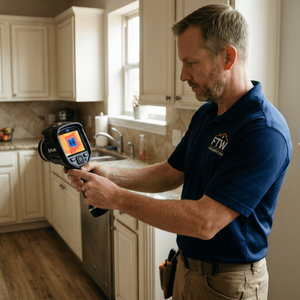
Thermal imaging uses infrared cameras to detect temperature variations invisible to the naked eye, revealing hidden moisture intrusion, insulation gaps, electrical hotspots, and air leaks that standard visual inspections miss. These cameras capture heat signatures that pinpoint problems before they become costly repairs, making them an essential tool for comprehensive home assessment in Fort Worth’s climate.
Understanding what thermal imaging can reveal helps you protect your investment and catch problems early.
Journey Home Inspections
Same-Day Detailed Report — 4,000+ Items Checked
Core Service Programs:
- Buyer & Seller Home Inspections for pre-purchase, pre-listing, and full general inspections covering 4,000+ items
- New Construction & Phase Inspections for new builds, phase checks, and 11-month builder warranty inspections
- Specialty Inspections for pool & spa, septic, well, irrigation, and pier & beam foundation systems
Why Choose Journey Home Inspections:
- ✓ Trusted by customers with a perfect 5.0-star Google rating across 79 verified reviews
- ✓ Family-owned, faith-based, and serving North Texas since 2016
- ✓ Led by Bryan Hughes — TREC-licensed (#21772) and insured
- ✓ InterNACHI Certified Professional Inspector
- ✓ 4,000+ items checked on every inspection — roof to foundation
- ✓ Same-day reports with photos, clear findings, and plain-language explanations
- ✓ Thermal imaging and drone technology on every inspection
How Thermal Imaging Works in Home Inspections
Thermal cameras don’t see light the way your eyes do—they detect infrared radiation, which is the heat energy that every object emits. By converting those heat signatures into a visible color image, the camera creates a map of temperature variations across walls, ceilings, floors, and mechanical systems. Warmer areas typically appear in red and yellow tones; cooler areas register as blue and purple.
What makes this technology so powerful is that different materials and conditions absorb and release heat at different rates. Wet drywall behaves differently than dry drywall. A section of wall with missing insulation loses heat faster than a properly insulated section. An overloaded electrical circuit generates heat that surrounding wiring does not. These differences create distinct thermal signatures that a trained inspector can read and interpret—without opening a single wall or disturbing the home in any way.
The process is entirely passive. The camera emits nothing—no radiation, no lasers, no harmful energy of any kind. It simply reads what’s already there. For Fort Worth homeowners, that means a thorough assessment of conditions that would otherwise remain completely hidden until they cause visible damage or system failure. If you’re weighing your inspection options, the general home inspection service page outlines how thermal imaging integrates into a full property assessment.
Why Hidden Problems Matter in Fort Worth Homes
Fort Worth’s climate—hot summers, occasional freeze-thaw cycles, and seasonal storms—creates conditions where moisture intrusion, insulation failure, and air leaks develop silently behind walls. Thermal imaging catches these problems before they compromise your home’s structure or safety.
Moisture and Water Intrusion Detection
Water damage is one of the most expensive and destructive problems a homeowner can face—and one of the most deceptive. By the time you see a stain on the ceiling or smell mildew in a closet, the damage has typically been progressing for weeks or months. Thermal imaging changes that timeline dramatically.
Wet materials retain moisture longer than dry ones, and that retained moisture creates a distinct temperature difference that shows up clearly on a thermal image. An active roof leak, for example, will appear as a cooler zone on the ceiling below—even if the drywall surface looks completely normal to the naked eye. The same principle applies to plumbing leaks behind walls, foundation seepage, and water infiltrating around window frames.
For Fort Worth homeowners specifically, this matters because of the region’s weather patterns. Heavy spring rains push water into any vulnerability in the building envelope. Occasional freeze-thaw cycles expand and contract materials, opening gaps that allow moisture to migrate into wall cavities. Once moisture takes hold in those hidden spaces, mold can begin developing within 24 to 48 hours under the right conditions. Structural damage and mold remediation costs can easily exceed $10,000—costs that early thermal detection can help you avoid entirely.
It’s worth noting that thermal imaging works best when there is an active temperature difference between wet and dry materials. Older, fully dried water stains may not produce a detectable thermal signature, which is why thermal imaging is most effective when paired with visual inspection and moisture meters as part of a comprehensive foundation and structural assessment.
Insulation Gaps and Energy Loss Revealed by Infrared Cameras
Insulation problems are nearly impossible to find without thermal imaging—unless you’re willing to open walls. Missing insulation, compressed batts, and improperly installed materials all create zones where conditioned air escapes and outside temperatures penetrate. On a thermal image, these gaps appear as cooler patches in winter or warmer patches in summer, tracing the exact outline of the problem area.
Thermal bridging is another phenomenon thermal cameras reveal clearly. This occurs when heat transfers through structural elements like wall studs and floor joists, bypassing the insulation entirely. It shows up as a regular linear pattern of temperature variation—the visual signature of a home losing energy through its own framing.
In Fort Worth, where summer temperatures routinely climb above 100°F and winters bring periodic cold snaps, insulation performance directly affects both comfort and utility costs. Industry estimates suggest that insulation gaps can increase heating and cooling bills by 15 to 30 percent. Identifying exactly where those gaps are located allows homeowners to prioritize targeted upgrades rather than guessing—a significant advantage when planning improvements to a property in Weatherford, Southlake, or anywhere across the DFW area. For a broader look at what a full inspection covers, the different types of inspections available provides helpful context.
Electrical and HVAC System Issues Detected by Thermal Cameras
Electrical problems are the leading cause of residential fires in the United States, and many of them are invisible until it’s too late. Overloaded circuits, loose connections, failing breakers, and deteriorating wiring all generate excess heat before they fail—and that heat is precisely what thermal imaging is designed to detect.
When an inspector scans an electrical panel with a thermal camera, hotspots appear as bright areas against the cooler background of properly functioning components. The same applies to outlets, switches, and junction boxes throughout the home. A single overloaded circuit identified during inspection is a fire hazard prevented. This is one of the most direct safety benefits thermal imaging provides—early warning of conditions that pose genuine risk to your family and your home.
HVAC systems tell their own thermal story. Refrigerant leaks cause temperature anomalies in the system’s cooling components. Blocked or disconnected duct runs show up as sections that aren’t delivering conditioned air. A failing compressor generates heat patterns that differ from a properly operating unit. Catching these issues before they become full system failures saves both the cost of emergency repairs and the discomfort of losing climate control during a Texas summer.
Red Flags Thermal Imaging Reveals
Watch for thermal patterns indicating electrical hotspots (fire hazard), large insulation gaps (energy waste), moisture accumulation (mold risk), and HVAC inefficiency (system failure). These issues require immediate professional attention and can cost thousands if left unaddressed.
Air Leaks and Building Envelope Integrity
A home’s building envelope—the barrier between conditioned interior space and the outside environment—is only as effective as its weakest points. Air leaks at those weak points force your HVAC system to work harder, drive up utility bills, and create conditions where moisture can accumulate inside wall cavities.
Thermal imaging makes air leaks visible by detecting the temperature differential they create. Cold air infiltrating around a window frame in winter appears as a distinct cool zone against the warmer surrounding wall. Warm outside air pushing through gaps around electrical outlets or plumbing penetrations in summer shows the reverse pattern. Common leak locations include window and door frames, attic access hatches, recessed lighting fixtures, and anywhere pipes or wires penetrate exterior walls.
For homeowners in Roanoke, Trophy Club, Argyle, and other communities across North Texas, where temperature swings between seasons can exceed 80 degrees, envelope integrity is a significant factor in both comfort and operating costs. Sealing identified air leaks is one of the highest-return improvements a homeowner can make—and thermal imaging tells you exactly where to focus that effort. If you’re preparing for a purchase and want to understand the full scope of what an inspection reveals, reviewing Fort Worth home inspection costs and what they cover is a useful starting point.
Maximize Your Inspection Investment
Request thermal imaging as part of your pre-purchase inspection, especially for older Fort Worth homes or properties with a history of water damage. Thermal data provides documentation of conditions at the time of inspection, protecting you in negotiations and future disputes.
Why Journey Home Inspections Is the Right Choice for Fort Worth Homeowners
Journey Home Inspections integrates thermal imaging into every comprehensive inspection—not as an add-on, not as an upgrade, but as a standard part of how every property is assessed. That means every Fort Worth homeowner who works with Journey gets the full picture: 4,000+ items checked, thermal imaging included, with a same-day detailed report delivered before you leave the property.
The team is led by Bryan Hughes, TREC-licensed inspector (#21772) and InterNACHI Certified Professional Inspector, with nearly a decade of serving North Texas homeowners across Fort Worth, Weatherford, Justin, Eagle Mountain, Southlake, Westlake, and the surrounding communities. That experience means Bryan knows what Fort Worth’s climate does to homes over time—the moisture pathways that develop after heavy spring rains, the insulation failures that compound through years of extreme heat, the electrical issues that age with older housing stock.
Journey Home Inspections has earned a perfect 5.0-star Google rating across 79 verified reviews since 2016—not by cutting corners, but by approaching every inspection with the same care a family-owned, faith-based business brings to everything it does. When you hire Journey, you’re not getting a checkbox inspection. You’re getting an honest, thorough assessment from someone who inspects your home the way they’d inspect their own.
Schedule your thermal imaging home inspection with Journey Home Inspections today
Frequently Asked Questions About Thermal Imaging Home Inspections
Thermal imaging is highly effective at detecting active moisture and recent water intrusion because wet materials retain heat differently than dry ones—producing a distinct temperature signature on camera. However, the technology works best when there is a meaningful temperature difference between the affected area and surrounding materials. Older, fully dried water stains may not show a detectable thermal pattern, which is why thermal imaging delivers the most complete results when combined with visual inspection and moisture meters. Together, these tools provide comprehensive detection that no single method achieves alone.
Thermal imaging is completely safe for both the home and everyone in it. Infrared cameras are passive devices that only detect heat radiation—they emit nothing whatsoever, no radiation, no lasers, no harmful energy of any kind. The inspection process is entirely non-invasive and non-destructive, requiring no access to walls, attics, or mechanical systems beyond what a visual inspection would require. Homeowners, children, and pets can remain in the home throughout the inspection without any concern.
When thermal imaging is offered as a standalone add-on, it typically adds $100 to $300 to the cost of a standard home inspection, depending on the inspector and region. Many inspectors, including Journey Home Inspections, include thermal imaging as a standard component of their comprehensive inspection package rather than charging separately for it. Given that early detection of hidden moisture, electrical hotspots, or insulation failures can prevent repair costs that routinely exceed $10,000, the investment in thermal imaging consistently delivers significant value relative to its cost.
A standard visual inspection relies on the inspector’s trained eyes and basic tools—flashlights, probes, moisture meters—to assess conditions that are accessible and visible. Thermal imaging adds a technological layer that detects temperature variations invisible to the naked eye, revealing hidden moisture, insulation gaps, electrical hotspots, and air leaks behind walls and above ceilings. Neither approach replaces the other; they work best together. A visual inspection provides context and physical verification, while thermal imaging extends the inspector’s reach into areas that cannot be seen directly, producing a far more complete picture of the property’s condition.
Journey Home Inspections combines advanced thermal imaging technology with TREC-licensed expertise and InterNACHI certification to deliver thorough, honest inspections across Fort Worth and the surrounding North Texas communities. Bryan Hughes and his team have maintained a perfect 5.0-star Google rating across 79 verified reviews since 2016 by checking 4,000+ items per inspection and delivering same-day reports with plain-language findings—no jargon, no guesswork. As a family-owned, faith-based business, Journey inspects every home with the care they’d give their own. Schedule your thermal imaging home inspection with Journey Home Inspections and get complete visibility into your property’s condition before you commit.
See What’s Hiding Behind Your Fort Worth Home’s Walls
Hidden moisture, insulation gaps, and electrical hotspots don’t announce themselves—they grow quietly until they become expensive emergencies. A thermal imaging inspection from Journey Home Inspections gives you the complete picture of your property’s condition, so you can make confident decisions and protect your investment from day one. Serving Fort Worth, Weatherford, Southlake, Eagle Mountain, Trophy Club, and communities across North Texas.
*Pricing, service availability, and inspection details mentioned in this article are accurate as of the date of publication and are subject to change. A home inspection reflects a property’s condition at the time of inspection and is not a warranty or guarantee. Please contact us directly to schedule an inspection of your specific property.