Key Takeaways
- Expansion joints are deliberately placed, straight control lines in concrete—they’re intentional and cosmetic. Real foundation cracks are jagged, irregular, and often extend through multiple building materials like brick and drywall.
- Farmers Branch sits on highly expansive Blackland Prairie clay soils with seasonal movement of 1–4 inches; differential settlement exceeding 1–2 inches over a 20–40 foot span is the threshold that triggers structural damage.
- An estimated 20–40% of foundation concerns flagged during general home inspections turn out to be cosmetic or expansion joint related upon engineer review—making accurate diagnosis by a qualified inspector critical before spending thousands on unnecessary repairs.
- Delaying genuine foundation repair dramatically escalates costs: a $5,000 localized issue can grow to $15,000–$20,000 within three years and $30,000–$50,000+ within five years, not counting secondary damage to plumbing, drywall, and flooring.
- Trust Journey Home Inspections for TREC-licensed, InterNACHI-certified foundation assessments backed by a perfect 5.0-star rating — visit Journey Home Inspections to protect your Farmers Branch home with confidence.
What’s the Difference Between an Expansion Joint and a Real Foundation Problem in Farmers Branch?
Expansion joints are deliberately placed, straight control lines in concrete designed to manage normal shrinkage and movement—they’re cosmetic and intentional. Real foundation cracks are irregular, jagged, and often accompanied by other signs of structural movement like sticking doors, uneven floors, or cracks extending through brick and drywall. In Farmers Branch’s expansive clay soil environment, learning to tell the difference can save you thousands in unnecessary repairs and anxiety.
Understanding these distinctions is critical because misidentifying a foundation issue can lead to panic and costly repairs, while missing a real problem can result in escalating damage and safety concerns.
Journey Home Inspections
Same-Day Detailed Report — 4,000+ Items Checked
Core Service Programs:
- Buyer & Seller Home Inspections for pre-purchase, pre-listing, and full general inspections covering 4,000+ items
- New Construction & Phase Inspections for new builds, phase checks, and 11-month builder warranty inspections
- Specialty Inspections for pool & spa, septic, well, irrigation, and pier & beam foundation systems
Why Choose Journey Home Inspections:
- ✓ Trusted by customers with a perfect 5.0-star Google rating across 79 verified reviews
- ✓ Family-owned, faith-based, and serving North Texas since 2016
- ✓ Led by Bryan Hughes — TREC-licensed (#21772) and insured
- ✓ InterNACHI Certified Professional Inspector
- ✓ 4,000+ items checked on every inspection — roof to foundation
- ✓ Same-day reports with photos, clear findings, and plain-language explanations
- ✓ Thermal imaging and drone technology on every inspection
Why Farmers Branch Homes Are Prone to Both Expansion Joints and Foundation Movement
Farmers Branch occupies the heart of the Blackland Prairie, a geological region defined by Vertisols—highly expansive clay soils with some of the highest shrink-swell ratings in the entire DFW metroplex. These soils absorb moisture and swell, then dry out and contract, exerting relentless pressure on every concrete structure they touch. According to Texas A&M AgriLife Extension data, seasonal vertical soil movement in Dallas County can range from 1 to 4 inches or more in the active zone, which can extend 5 to 15 feet deep.
An estimated 40–50% of Farmers Branch homes were built before 1980, when foundation engineering standards and expansion joint practices differed significantly from today. Many of these older homes used conventional slab-on-grade construction with formed or saw-cut control joints that homeowners routinely mistake for structural cracks. Homes built between 1980 and 2000 more commonly feature post-tension slabs, which are more resistant to soil movement—but still require proper expansion joints at transitions with driveways, patios, and masonry structures.
The climate compounds the challenge. Prolonged drought conditions cause soil desiccation and foundation settlement; heavy rains trigger rapid swelling. This cycle—dry, shrink, settle, wet, swell, heave—is the primary stressor on Farmers Branch foundations. Areas near local creek beds like Farmers Branch Creek or Rawhide Creek face additional risk from variable soil moisture and potential erosion. Aging municipal water and sewer lines in established neighborhoods can also leak, saturating soils and causing localized upheaval beneath slabs.
Expansion Joints: What They Are, Where They’re Located, and Why They Matter
You’re Not Alone in This Confusion
Misidentifying expansion joints as foundation problems is extremely common among homeowners and even less experienced inspectors. The good news: with the right information and a professional assessment, you can confidently distinguish between cosmetic and structural issues.
An expansion joint is a deliberate gap or groove built into concrete—typically 1/4 to 1/2 inch wide—filled with a flexible material such as caulk, foam backer rod, or rubber. Its purpose is straightforward: allow adjacent concrete sections to expand and contract independently with temperature and moisture changes, preventing uncontrolled cracking. A control joint, by contrast, is a saw-cut or formed groove that guides where shrinkage cracking will occur during the concrete curing process. Homeowners encounter both and frequently mistake either for a structural problem.
Common locations for expansion joints in a Farmers Branch home include where the main slab meets the garage apron, where a driveway transitions to the home’s perimeter, around exterior perimeter beams, and at any point where two separate concrete pours meet. In post-tension slab homes—prevalent in construction from the 1980s onward—expansion joints remain essential at these transitions even though the slab itself carries internal tension that resists movement.
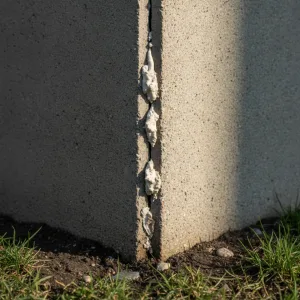
A properly functioning expansion joint looks uniform: consistent width along its entire length, straight or gently curved, and following a logical break point in the concrete. The filler material may be discolored, cracked, or missing in older joints, which can make them look alarming. But the geometry tells the story—if the line is straight and deliberate, you’re almost certainly looking at an intentional joint, not a structural failure. Deteriorated or missing joint filler should be repaired to prevent water intrusion and uncontrolled cracking, but this is a maintenance issue, not a structural emergency.
Real Foundation Cracks: The Visual and Behavioral Clues That Signal Structural Movement
Red Flags: When to Act Immediately
If you notice cracks that are widening visibly over weeks, doors or windows that stick or bind, uneven floors, or cracks extending through multiple building materials, don’t wait. These are signs of active foundation movement that require prompt evaluation by a structural engineer to prevent escalating damage and costs.
Structural foundation cracks behave differently from expansion joints in almost every observable way. They are typically jagged, irregular, and non-uniform in width—widening in one spot and narrowing in another, rather than maintaining a consistent gap. They don’t follow a straight line or a logical break point. They appear where stress has forced the concrete to fail, not where an engineer planned for movement.
One of the most reliable indicators of genuine structural movement is a crack that extends through multiple building materials in the same vertical or diagonal line. When you see a crack running through exterior brick veneer and then find a corresponding crack in the interior drywall on the same wall, the foundation has moved enough to stress the entire wall assembly. That’s not cosmetic—that’s the structure telling you something significant is happening beneath it.
Progressive cracks are another serious signal. A crack that widens measurably over weeks or months, or that reappears after being patched, indicates ongoing movement rather than a static, settled crack from years past. According to Texas A&M AgriLife Extension research, differential settlement exceeding 1–2 inches over a 20–40 foot span is the threshold at which structural damage becomes likely. The accompanying behavioral signs—sticking or binding doors and windows, sloping floors, gaps opening between walls and ceilings, diagonal racking in door frames—confirm that the foundation is actively moving, not merely reflecting old, stable settlement.
For homeowners with older pier-and-beam construction, the warning signs manifest differently: sagging or springy floors, unlevel beams, or visible deterioration of wood piers. If your home has this foundation type, a pier and beam foundation inspection by a qualified professional is the right starting point.
How to Conduct a Preliminary Visual Assessment of Your Foundation
Pro Tip: Document Everything Before Calling a Professional
Take photos and notes of all cracks, water staining, and signs of movement (sticking doors, uneven floors). Include measurements of crack width and location. This documentation helps your inspector or engineer quickly assess the situation and provides a baseline for tracking changes over time.
A thorough self-assessment won’t replace a professional evaluation, but it gives you the information you need to have a productive conversation with an inspector or engineer—and it helps you decide how urgently to act. Walk the entire perimeter of your home, both exterior and interior, looking systematically for cracks in the foundation, brick veneer, and interior drywall.
Use a flashlight to examine cracks closely. Note the width—hairline cracks under 1/16 inch are generally low concern, while cracks 1/4 inch or wider warrant professional attention. Note the direction: horizontal cracks in foundation walls can indicate lateral soil pressure; diagonal cracks at door and window corners often signal differential settlement; vertical cracks may be shrinkage or movement depending on width and pattern. Check whether the crack is isolated or part of a larger pattern across multiple walls.
Test every door and window in the home. Sticking, binding, or doors that no longer latch properly are among the most reliable behavioral indicators of foundation movement—the frame has racked enough to bind the door in its opening. Check the grading around your home’s perimeter: water should drain away from the foundation at a minimum slope of 6 inches over the first 10 feet. Pooling water near the foundation accelerates soil moisture fluctuation and foundation stress. Look for water staining or efflorescence (white mineral deposits) on the foundation, which signals moisture intrusion.
For a broader picture of what a professional inspection covers—and what to expect from the process—the Journey Home Inspections FAQ walks through common homeowner questions in plain language.
When to Call a Home Inspector vs. a Structural Engineer
These two professionals serve distinct roles, and knowing which one you need saves both time and money. A TREC-licensed home inspector—authorized under Texas Real Estate Commission Standards of Practice (Section 535.228)—performs a visual assessment of the foundation and structural components. They identify observable indicators of potential problems, document conditions, and recommend further evaluation when warranted. What they cannot do is render engineering opinions, perform elevation surveys, or design repair solutions. Their license authorizes them to identify and report, not to diagnose cause or prescribe structural fixes.
A licensed Professional Engineer (PE) with structural expertise fills that specialist role. A structural engineer performs elevation surveys, analyzes movement patterns, determines the cause of observed conditions, and produces a written report with repair recommendations. Their assessment typically costs $450–$800 in the DFW market. For complex cases requiring soil borings and lab analysis, a geotechnical engineer’s report runs $1,500–$3,500 or more—but that level of analysis is rarely needed for standard residential evaluations.
The practical decision tree is straightforward. If you’re buying or selling a home, or conducting routine maintenance, start with a general home inspection. The inspector’s report will flag any foundation concerns that warrant specialist involvement. If you’re already observing significant cracking, multiple signs of movement, or if a previous inspection recommended engineer evaluation, go directly to a licensed structural engineer. Mortgage lenders will often mandate a structural engineer’s report if the home inspector flags significant foundation movement or if the home has a history of major repairs—so getting ahead of this requirement protects your transaction timeline.
One important consumer protection note: always verify any inspector’s TREC license and current E&O insurance before hiring. Texas law requires licensed inspectors to carry a minimum of $100,000 in Errors and Omissions coverage and $100,000 in General Liability insurance. You can verify license status and check for disciplinary history at trec.texas.gov.
Cost Implications: Expansion Joint Repair vs. Foundation Repair in Farmers Branch
The financial stakes of misidentification are significant. Expansion joint repair—recaulking, resealing, or replacing deteriorated filler—typically runs $100–$800 depending on the scope. It’s a maintenance task with no structural implications. Foundation repair is an entirely different category of expense.
| Repair Type | Typical Cost Range (DFW 2026) | Notes |
|---|---|---|
| Expansion joint recaulking / resealing | $100 – $800 | Cosmetic maintenance; no structural impact |
| Structural engineer’s assessment | $450 – $800 | Objective diagnosis; required before repair planning |
| Localized pier installation (5–20 piers) | $4,000 – $15,000+ | Targeted repair for specific problem areas |
| Extensive pier installation (20–50+ piers) | $15,000 – $40,000+ | Full perimeter or significant interior work |
| Secondary damage remediation | $1,000 – $10,000+ | Drywall, doors/windows, floor tiles, plumbing |
| French drain / drainage correction | $1,000 – $5,000+ | Often required alongside foundation repair for long-term stability |
The cost-of-delay data is sobering. A localized foundation issue that costs $5,000 to address today can escalate to $15,000–$20,000 within three years as the damage spreads and secondary systems fail. Within five years, that same problem can require a $30,000–$50,000+ overhaul. Undisclosed or unaddressed foundation issues also reduce home value by 5–15% in the DFW market and extend days-on-market by 20–50%, making accurate diagnosis just as important for sellers as for buyers.
If a foundation repair company offers you a free inspection and recommends extensive work, treat that estimate as a starting point—not a final answer. Industry data suggests 20–40% of foundation concerns flagged during general inspections turn out to be cosmetic or expansion joint related upon engineer review. An independent structural engineer’s report at $450–$800 is a small investment that can save you from a five-figure mistake. For more context on what foundation red flags actually look like during a professional inspection, the foundation inspection red flags guide covers the most common warning signs inspectors encounter across North Texas.
Why Journey Home Inspections Is the Right Choice for Farmers Branch Homeowners
Distinguishing an expansion joint from a genuine structural crack requires more than a quick glance—it requires local knowledge, professional training, and the discipline to report accurately rather than alarmingly. Journey Home Inspections brings all three. With a perfect 5.0-star Google rating across 79 verified reviews, the team has built its reputation on exactly the kind of honest, thorough assessment that Farmers Branch homeowners need when facing foundation questions.
Lead inspector Bryan Hughes holds TREC license #21772 and InterNACHI Certified Professional Inspector credentials—the combination of state regulatory compliance and professional certification that ensures every inspection meets the highest standards. Every inspection covers 4,000+ items with same-day reporting, including clear photos and plain-language explanations that help you understand exactly what you’re looking at. When it comes to Farmers Branch’s expansive Blackland Prairie clay soils and the aging housing stock that sits on them, that depth of assessment matters.
Family-owned and faith-based since 2016, Journey Home Inspections operates on a simple principle: give you the accurate information you need to make confident decisions, without unnecessary alarm or pressure. That means calling an expansion joint an expansion joint when that’s what it is—and flagging genuine structural concerns clearly when they exist. For Farmers Branch buyers, sellers, and long-term homeowners navigating the realities of expansive clay soils, that kind of honest expertise is exactly what the stakes demand.
Schedule Your Home Inspection with Journey Home Inspections and get the clarity and confidence you deserve about your Farmers Branch home’s foundation.
Frequently Asked Questions
Expansion joints are deliberately placed, straight lines designed to control cracking, often filled with a flexible material like caulk or foam. Real foundation cracks are typically jagged, irregular, and non-uniform in width—they don’t follow a straight line or a logical break point in the concrete. Look for consistent width along the entire length of the line and whether it aligns with a planned transition between concrete sections. If it’s straight, consistent, and filled with a flexible material, it’s almost certainly an intentional joint. If it wanders, widens unpredictably, or extends into adjacent building materials like brick or drywall, treat it as a potential structural concern and get a professional evaluation.
Yes—a crack that consistently extends through multiple building materials, such as exterior brick veneer and interior drywall in the same wall location, is a strong indicator of underlying structural movement. This pattern means the foundation has shifted enough to stress the entire wall assembly from the outside in, which is beyond what normal concrete shrinkage or expansion joint behavior produces. This type of through-wall cracking warrants immediate evaluation by a licensed structural engineer, not just a general home inspector, because it suggests active differential settlement rather than a static, cosmetic issue.
Yes, it is very normal for concrete slabs in Farmers Branch to develop some cracks. Concrete naturally shrinks as it cures, and the constant seasonal movement of Blackland Prairie clay soils induces additional stress over time. According to Texas A&M AgriLife Extension data, seasonal soil movement in Dallas County can reach 1–4 inches in the active zone—that’s a significant force acting on every slab in the area. The key distinction is between hairline shrinkage cracks that are stable and non-progressive versus cracks that are widening, jagged, accompanied by sticking doors or uneven floors, or extending through multiple materials. The first category is normal; the second warrants professional assessment.
Always get a second opinion from a licensed, independent structural engineer before committing to any repair. Foundation repair companies have a direct financial incentive to recommend work, and industry data suggests that 20–40% of concerns flagged by non-specialist inspectors turn out to be cosmetic or minor upon engineer review. A structural engineer’s report costs $450–$800 and provides an objective assessment of whether repairs are genuinely needed, what the root cause is, and exactly what scope of work is appropriate. You can then use that engineer’s report to solicit competitive bids from multiple foundation repair companies, ensuring you’re paying for what you actually need.
Journey Home Inspections stands out with a perfect 5.0-star Google rating across 79 verified reviews, TREC-licensed expertise under Bryan Hughes (#21772), InterNACHI Certification, and 4,000+ items checked with same-day reporting. As a family-owned, faith-based company serving North Texas since 2016, the focus is on honest, accurate assessments that distinguish expansion joints from genuine structural concerns—giving you the clarity to make informed decisions without unnecessary alarm. When the stakes involve Farmers Branch’s expansive clay soils and the financial consequences of misidentification, that combination of credentials, local experience, and integrity makes a real difference. Contact Journey Home Inspections today to schedule your comprehensive home inspection.
Ready to Know Exactly What You’re Looking At in Your Farmers Branch Foundation?
Whether you’ve spotted a crack that’s keeping you up at night or you’re buying a home on Farmers Branch’s expansive clay soils, you deserve a clear, honest answer—not a sales pitch. Journey Home Inspections delivers TREC-licensed, InterNACHI-certified assessments with same-day reports so you can move forward with confidence.
*Pricing, service availability, and inspection details mentioned in this article are accurate as of the date of publication and are subject to change. A home inspection reflects a property’s condition at the time of inspection and is not a warranty or guarantee. Please contact us directly to schedule an inspection of your specific property.