Key Takeaways
- Mold severity depends on location, extent, and moisture source — small, isolated mold with a fixable cause is often manageable through professional remediation and seller negotiation, while extensive or hidden mold may warrant walking away.
- DFW mold remediation costs range from $500–$1,500 for small areas to $7,000–$30,000+ for attic, crawl space, or HVAC projects — always budget an additional 10–15% for hidden costs like moisture source repairs, reconstruction, and clearance testing.
- Texas law requires separate TDLR licenses for mold assessors and mold remediation contractors — the same company cannot legally perform both on the same job, a protection buyers should always verify at tdlr.texas.gov.
- In the 2026 DFW market, buyers have more negotiating leverage than during peak seller’s market years — seller credits at closing to cover remediation costs are the most common outcome when mold is discovered during inspection.
- Trust Journey Home Inspections for thorough, same-day reporting and family-owned expertise that catches moisture issues before they become costly mold problems — visit Journey Home Inspections to protect your investment from day one.
Mold Found on Home Inspection: How Serious Is It & What Should You Do?
Mold severity depends on location, extent, and the underlying moisture source — not all mold findings are deal-breakers. Small, isolated mold in easily accessible areas with fixable causes (like a roof leak) is often manageable through professional remediation and seller negotiation. However, extensive mold, hidden mold behind walls, or mold stemming from major structural issues requires careful evaluation and may warrant walking away from the purchase.
Understanding the seriousness of your specific mold finding and knowing your options as a buyer is critical to making an informed decision in the DFW real estate market.
Journey Home Inspections
Same-Day Detailed Report — 4,000+ Items Checked
Core Service Programs:
- Buyer & Seller Home Inspections for pre-purchase, pre-listing, and full general inspections covering 4,000+ items
- New Construction & Phase Inspections for new builds, phase checks, and 11-month builder warranty inspections
- Specialty Inspections for pool & spa, septic, well, irrigation, and pier & beam foundation systems
Why Choose Journey Home Inspections:
- ✓ Trusted by customers with a perfect 5.0-star Google rating across 79 verified reviews
- ✓ Family-owned, faith-based, and serving North Texas since 2016
- ✓ Led by Bryan Hughes — TREC-licensed (#21772) and insured
- ✓ InterNACHI Certified Professional Inspector
- ✓ 4,000+ items checked on every inspection — roof to foundation
- ✓ Same-day reports with photos, clear findings, and plain-language explanations
- ✓ Thermal imaging and drone technology on every inspection
Understanding Mold Severity: Location, Extent, and Moisture Source
When a home inspector flags mold or moisture conditions during a DFW inspection, the first question buyers ask is understandable: how bad is it? The honest answer is that severity is determined by three factors working together — where the mold is located, how much of it exists, and what’s causing the moisture that feeds it. Getting those three answers clearly is the foundation of every smart decision that follows.
Nationally, moisture intrusion and conditions conducive to mold are among the most common deficiencies found in home inspections, according to InterNACHI and ASHI data from 2025. North Texas’s climate amplifies that risk: high spring and summer humidity, intense heat driving condensation inside walls, and the region’s reactive clay soils causing foundation movement that can crack slabs and introduce water pathways all create conditions where mold can establish itself quickly. According to EPA research, mold spores can begin colonizing within 24 to 48 hours of a moisture event — meaning a roof leak after a heavy DFW spring rain can become a mold problem faster than most buyers realize.
Finding Mold Doesn’t Mean the Deal Is Over
Many buyers panic when mold is discovered, but small, isolated mold with a fixable moisture source is often manageable through professional remediation and seller negotiation. Understanding the severity and your options empowers you to make a confident decision rather than react emotionally.
Mold in Attics and Crawl Spaces
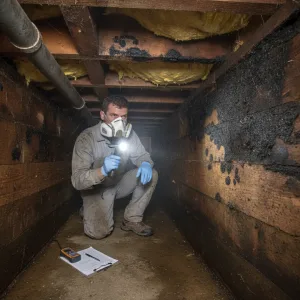
Attic mold is one of the most common findings in older DFW homes, often tracing back to inadequate ventilation or a roof leak rather than active indoor contamination. If the attic is well-sealed from the living area, occupants may not experience immediate air quality effects — but that doesn’t mean it’s minor. Left unaddressed, attic mold can spread to roof decking and framing, escalating from a remediation project into a structural repair. Pier-and-beam homes, which are common in older Fort Worth and Weatherford neighborhoods, face similar risks in crawl spaces, where poor drainage and limited airflow create persistently damp conditions. A pier-and-beam foundation inspection can help identify whether crawl space moisture is tied to a foundation or drainage issue that needs to be addressed alongside remediation.
Mold in Living Spaces, Bathrooms, and HVAC Systems
Mold inside the conditioned envelope of the home — in bathrooms, on walls, or within the HVAC system — is more immediately serious. HVAC mold is particularly concerning because the system distributes air throughout the entire home, meaning spores can reach every room continuously. This is the scenario where health impacts are most direct: the CDC confirms that mold exposure can cause nasal stuffiness, throat irritation, coughing, wheezing, and eye irritation, with children, elderly individuals, and immunocompromised persons facing greater risk. If your inspection report flags mold near the air handler, evaporator coils, or ductwork, treat it as a priority finding requiring professional assessment before closing.
Hidden Mold Behind Walls and in Wall Cavities
Hidden mold is the most serious category because it almost always indicates prolonged, undetected moisture intrusion. By the time mold establishes itself behind drywall, the moisture source has typically been active for weeks or months. Remediation requires opening walls, removing contaminated materials, and addressing whatever leak or structural issue allowed water in — often a combination of plumbing failure, foundation movement, or window intrusion. In North Texas, where expansive clay soils cause significant foundation shifts during drought-flood cycles, hidden wall mold can sometimes trace back to foundation issues. If your inspector notes staining, soft drywall, or musty odors in wall areas, a licensed mold assessor should investigate before you commit to the purchase. The foundation red flags buyers should know in Fort Worth often overlap with the conditions that drive hidden moisture intrusion.
DFW Mold Remediation Costs: What Buyers Should Budget
One of the most practical things a buyer can do after a mold finding is get clear on the real numbers. Remediation quotes vary significantly based on scope, and the initial quote rarely tells the full financial story.
For small, isolated mold areas under 10 square feet — a bathroom corner, under a sink — professional remediation in DFW typically runs $500 to $1,500, with assessment and clearance testing adding $250 to $800. Moderate infestations covering 10 to 100 square feet, such as a section of attic or a wall cavity, generally cost $2,000 to $6,000 for remediation alone; when you add assessment, moisture source repair, reconstruction, and clearance testing, total project costs commonly reach $4,000 to $10,000. Large or systemic projects — affecting attics, crawl spaces, HVAC systems, or multiple areas — range from $7,000 to $30,000 or more, depending on the extent of demolition and structural repairs required.
Get Multiple Quotes and Budget for Hidden Costs
Initial mold remediation quotes often don’t include moisture source repairs, reconstruction, HVAC cleaning, or clearance testing. Always ask for a detailed breakdown and budget 10–15% extra for unforeseen costs. This prevents sticker shock during negotiations and helps you evaluate true financial impact.
Hidden Costs Buyers Often Overlook
The remediation quote is rarely the full bill. Fixing the moisture source — the actual cause of the mold — is a separate cost that can range from a few hundred dollars for a minor plumbing drip to $5,000–$50,000 for foundation-related water intrusion. After mold is removed, damaged drywall, insulation, and flooring must be replaced, adding $1,000 to $10,000 or more in reconstruction costs. If the HVAC system is involved, professional duct cleaning runs $300 to $1,000, while partial or full system replacement can reach $15,000. Post-remediation clearance testing by a licensed mold assessor — a mandatory step in Texas — typically costs $300 to $800 and is frequently omitted from initial contractor quotes. Build all of these into your negotiation figure, not just the remediation line item.
It’s also worth noting that standard homeowner insurance policies often exclude mold damage unless it stems from a sudden, covered peril like a burst pipe. Texas Department of Insurance guidance from 2025 confirms that mold resulting from long-term neglect or maintenance issues is typically not covered — meaning buyers who close without addressing mold findings may face the full cost out of pocket.
Texas Licensing and Regulatory Requirements: Protecting Yourself
Texas has one of the strongest consumer protection frameworks for mold work in the country, and understanding it is one of the most practical things a DFW buyer can do. Under Texas Occupations Code Chapter 1958, all mold assessment and remediation work must be performed by professionals licensed by the Texas Department of Licensing and Regulation (TDLR). There are distinct license types: Mold Assessors investigate, identify, and write remediation protocols; Mold Remediation Contractors physically remove mold following those protocols; and Mold Remediation Workers perform the hands-on removal under contractor supervision.
The most important rule for buyers to understand: the same company cannot legally perform both the assessment and the remediation on the same job. This separation of duties is a built-in consumer protection. It ensures an independent assessor writes the protocol, an independent remediator follows it, and then the original assessor returns to perform clearance testing — verifying the work was actually done correctly. Without this check, there’s no independent confirmation that your mold problem has been resolved.
Home inspectors operate under a different framework. TREC Standards of Practice require inspectors to report visible moisture penetration and conditions conducive to mold, but inspectors are not licensed mold assessors and are not required to identify mold type or perform sampling. When an inspector flags moisture or mold-like conditions, the next step is always a licensed mold assessor — not another general inspection. For a deeper look at what a thorough home inspection covers and how it connects to mold risk, the guide to mold inspections in Fort Worth homes covers when to test and what results mean.
Beware of Unlicensed Mold Contractors in Texas
Texas law requires separate TDLR licenses for mold assessors and remediators. Any contractor claiming they don’t need a license, offering to both assess and remediate, or pressuring you to start work without a written protocol is operating illegally and removing your consumer protections. Always verify licenses at tdlr.texas.gov before hiring.
How to Verify a Contractor’s License
Verifying a license takes less than five minutes. Go to tdlr.texas.gov, navigate to the License Search tool, select “Mold Assessors and Remediators,” and enter the individual’s or company’s name or license number. The results show current license status, expiration date, and any public disciplinary actions. Also confirm the contractor carries both general liability and pollution liability insurance — licensed contractors are required to maintain commercial general liability coverage of at least $500,000 per occurrence. Never hire a mold professional without verifying both the license and the insurance.
Red Flags: Unlicensed or Unethical Operators
Any contractor who claims they don’t need a TDLR license for mold work in Texas is operating illegally — full stop. Companies offering to both assess and remediate are violating state law and eliminating the independent verification that protects you. Pressure to start work immediately without a written protocol or detailed quote is a serious warning sign, as is any refusal to provide post-remediation clearance testing. Improper methods — like spraying bleach over mold surfaces without removal — don’t eliminate mold at its roots and can worsen health effects. Insist on a written scope of work, verify the license, and get at least two quotes before authorizing any mold work.
Negotiation Strategies for DFW Buyers: Who Pays and How
Discovering mold during inspection doesn’t end the transaction — it opens a negotiation. In the 2026 DFW market, buyers have meaningfully more leverage than during the peak seller’s market years of 2023 and early 2024. Active listings in DFW were up 10–15% year-over-year as of early 2026, and sustained higher mortgage rates (Freddie Mac reported 6.43% as of July 2026) have cooled the frenzy that once pushed buyers to waive inspection contingencies entirely. Sellers know the market has shifted, and mold findings carry real negotiating weight.
The most common outcome in the current DFW market is a seller credit at closing. The buyer obtains a professional mold assessment and at least two remediation quotes, then requests a credit equal to the full estimated cost plus a 10–15% contingency buffer. This approach keeps the transaction moving and gives the buyer control over who performs the work and how it’s done — a significant advantage over demanding seller-completed remediation, which can delay closing and leave you with less oversight of quality. That said, if the mold is extensive or the moisture source is severe, demanding seller-completed remediation with independent clearance documentation before closing shifts the risk appropriately. Walking away remains a legitimate choice when mold is widespread, the underlying cause is a major structural issue, or the seller refuses to negotiate in good faith.
Step-by-Step Negotiation Process
Start by engaging a TDLR-licensed mold assessor immediately after the inspection finding — don’t wait. Once you have the assessment report and remediation protocol in hand, obtain detailed quotes from at least two licensed remediation contractors. Present the full documentation to your real estate agent and, for significant findings, a Texas real estate attorney. Request a seller credit covering the complete scope: remediation, moisture source repair, reconstruction, and clearance testing. If the seller refuses a reasonable credit, weigh whether a price reduction, seller-managed remediation with clearance documentation, or contract termination best protects your interests. The case for professional home inspections for buyers and sellers explains why this documentation process matters far beyond the mold issue itself.
Health Impacts and When Mold Is a Deal-Breaker
There are no federal or state standards defining an “acceptable” level of indoor mold — the EPA’s position is straightforward: visible mold growth is unacceptable and requires remediation. The CDC confirms that mold exposure causes nasal stuffiness, throat irritation, coughing, wheezing, and eye irritation, with greater risk for children, elderly individuals, and anyone with allergies, asthma, or compromised immune function. For families with young children or members with respiratory conditions, this isn’t abstract risk — it’s a real and immediate concern that should factor heavily into the purchase decision.
Certain mold scenarios are legitimate deal-breakers regardless of seller willingness to negotiate. Extensive hidden mold behind walls or in multiple areas of the home signals a systemic, long-standing moisture problem that is difficult to fully scope before closing. Mold stemming from major structural issues — foundation cracks, widespread plumbing failure, or chronic drainage problems — means the moisture source itself may cost tens of thousands of dollars to resolve, separate from remediation. And if a seller is unwilling to negotiate in good faith on a documented mold finding, that posture itself is informative about what else may be undisclosed. Walking away, while emotionally difficult after investing time and inspection fees, is sometimes the financially and medically sound choice.
Why Journey Home Inspections Is the Right Choice for DFW Buyers
When mold or moisture shows up during a home inspection, the quality of that inspection report determines everything that follows — your ability to negotiate, your ability to obtain accurate remediation quotes, and your ability to make a confident decision under real time pressure. Journey Home Inspections has built its reputation in the DFW market on exactly this kind of thorough, trustworthy work since 2016.
The numbers reflect that reputation: a perfect 5.0-star Google rating across 79 verified reviews, earned by consistently delivering clear, detailed reports that buyers can actually use. TREC-licensed inspector Bryan Hughes (#21772) holds InterNACHI Certified Professional Inspector credentials and leads a team that checks 4,000+ items on every inspection — roof to foundation — with same-day reporting that includes photos, plain-language findings, and thermal imaging. In a market where moisture intrusion from North Texas clay soils, aging HVAC systems, and seasonal rainfall is a persistent risk, that level of thoroughness isn’t a bonus — it’s the baseline buyers deserve.
Journey Home Inspections is family-owned and faith-based, serving Fort Worth, Weatherford, Justin, Southlake, Westlake, Argyle, Trophy Club, Eagle Mountain, Roanoke, and communities across the DFW metro. When moisture or mold-conducive conditions are identified, the detailed professional report becomes the foundation for every step that follows: the mold assessor’s engagement, the remediation quotes, and the negotiation with the seller. That documentation is your protection.
Schedule Your Home Inspection Today
Frequently Asked Questions
Yes — the implications differ in meaningful ways. Attic mold typically traces back to ventilation deficiencies or roof leaks and may not immediately affect indoor air quality if the attic is well-sealed from living areas. Mold in living spaces, bathrooms, or HVAC systems directly exposes occupants and signals active moisture problems within the home’s conditioned envelope, making it more urgent. Both scenarios require a TDLR-licensed mold assessor and professional remediation, but living space and HVAC mold should be treated as higher priority findings given the direct health exposure risk.
Costs are negotiated between buyer and seller, and the outcome depends on mold severity, buyer leverage, and market conditions. The most common result in the 2026 DFW market is a seller credit at closing — the buyer obtains a professional assessment and remediation quotes, then requests a credit to cover the full scope of work. Alternatively, buyers may demand seller-completed remediation with independent clearance documentation before closing, or negotiate a purchase price reduction. In the current market, with inventory up and buyer frenzy cooled by higher interest rates, buyers generally have more room to negotiate mold-related concessions than they did in 2023 or early 2024.
A TDLR-licensed mold assessor’s report includes visual inspection findings, locations and types of mold identified (if sampled), moisture readings, and photographs. The most critical section is the Remediation Protocol — the step-by-step written plan a licensed remediator must follow to safely remove mold, address the moisture source, maintain proper containment, and arrange post-remediation clearance testing. This protocol is your legal and practical roadmap: it defines the scope of work remediators must quote against, and the independent clearance test at the end confirms the job was completed correctly. Without a written protocol, you have no enforceable standard for the remediation work.
Texas law requires sellers to disclose known material defects on the TREC Seller’s Disclosure Notice, including active mold or past mold remediation. If you discover significant, undisclosed mold after closing and can demonstrate the seller had knowledge and intentionally concealed it, you may have legal recourse under the Texas Deceptive Trade Practices Act (DTPA) or for fraudulent misrepresentation — potentially including recovery of economic damages, mental anguish damages, and in cases of knowing violations, treble damages. Consulting a Texas real estate attorney immediately is essential to evaluate your specific situation, gather evidence, and understand the timeline for filing a claim.
Journey Home Inspections brings a perfect 5.0-star Google rating across 79 verified reviews, reflecting consistent excellence across hundreds of DFW inspections since 2016. The team is family-owned and faith-based, led by TREC-licensed inspector Bryan Hughes (#21772) who holds InterNACHI Certified Professional Inspector credentials. Every inspection covers 4,000+ items with same-day reporting, thermal imaging, and drone technology — giving buyers the speed and detail they need to make confident decisions, especially when moisture or mold-conducive conditions are identified. That detailed professional report becomes the foundation for mold assessor engagement, remediation quotes, and seller negotiations. Schedule your home inspection to get the thorough, trustworthy inspection DFW buyers deserve.
Mold Found on Inspection? Get the Report That Protects You.
A thorough inspection report is your first and most important line of defense when mold or moisture shows up during the home buying process. Journey Home Inspections delivers same-day, 4,000+ item inspections with the detail and clarity DFW buyers need to negotiate confidently and protect their investment. Don’t navigate a mold finding without the right documentation in your corner.
*Pricing, service availability, and inspection details mentioned in this article are accurate as of the date of publication and are subject to change. A home inspection reflects a property’s condition at the time of inspection and is not a warranty or guarantee. Please contact us directly to schedule an inspection of your specific property.