Key Takeaways
- Corner pop—a hairline crack in brick veneer at a corner—is typically cosmetic and does not require structural repair; it should be monitored but rarely demands urgent action.
- Structural foundation issues involve wide, continuous cracks (greater than ¼ inch), measurable slab settlement, and interior distress such as sticking doors, racked frames, and cracked floor tiles—these require immediate professional evaluation.
- North Texas’s expansive Blackland Prairie clay soils cause measurable foundation movement in an estimated 80–95% of DFW homes over their lifespan; the key is distinguishing manageable cosmetic movement from serious structural failure.
- Delaying structural foundation repair in expansive clay environments can escalate a $5,000–$8,000 localized fix into a $20,000–$40,000+ perimeter-and-interior repair within just 1–3 years.
- Trust Journey Home Inspections for conflict-free, expert foundation assessment backed by a perfect 5.0-star Google rating and deep North Texas expertise — visit Journey Home Inspections to protect your most important investment.
Corner Pop vs. Structural Issues: Which Foundation Problem Should You Worry About in North Texas?
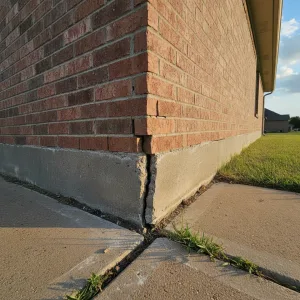
Corner pop—a hairline crack in brick veneer at a corner—is typically cosmetic and requires no structural repair, while true structural foundation issues involve wide, continuous cracks, measurable settlement, and interior distress that demand immediate professional evaluation. The key distinction lies in the extent and progression of movement: cosmetic issues are isolated and stable, while structural failures are widespread, active, and compromise your home’s integrity. Understanding this difference can save you thousands in unnecessary repairs and help you make informed decisions during a home purchase or when addressing existing concerns.
In North Texas’s expansive clay soil environment, foundation movement is nearly universal—but not all movement is created equal.
Journey Home Inspections
Same-Day Detailed Report — 4,000+ Items Checked
Core Service Programs:
- Buyer & Seller Home Inspections for pre-purchase, pre-listing, and full general inspections covering 4,000+ items
- New Construction & Phase Inspections for new builds, phase checks, and 11-month builder warranty inspections
- Specialty Inspections for pool & spa, septic, well, irrigation, and pier & beam foundation systems
Why Choose Journey Home Inspections:
- ✓ Trusted by customers with a perfect 5.0-star Google rating across 79 verified reviews
- ✓ Family-owned, faith-based, and serving North Texas since 2016
- ✓ Led by Bryan Hughes — TREC-licensed (#21772) and insured
- ✓ InterNACHI Certified Professional Inspector
- ✓ 4,000+ items checked on every inspection — roof to foundation
- ✓ Same-day reports with photos, clear findings, and plain-language explanations
- ✓ Thermal imaging and drone technology on every inspection
What Is Corner Pop and Why Does It Happen in North Texas?
Corner pop is a specific, localized crack pattern that appears in brick veneer at the corners of a home—typically a hairline fracture running through mortar joints, and occasionally through the face of a brick itself. It does not extend into the structural slab beneath, and it does not propagate into interior drywall. That isolation is what makes it cosmetic rather than structural.
It forms when two forces combine: minor, localized slab movement at an exposed corner, and brick veneer that lacks adequate support or articulation at that corner. Corners are the most exposed part of any exterior wall—they receive direct sun from two directions, experience greater temperature swings, and are the first areas to dry out when North Texas summers turn brutal. When the soil beneath a corner dries and contracts even slightly, the brick veneer at that point bears the stress. Without proper control joints to absorb that movement, the mortar cracks.
This is extremely common in DFW’s brick veneer homes on slab foundations. The Blackland Prairie clay soils that underlie most of North Texas shrink and swell with every rain-and-drought cycle, and corners feel that movement first and most acutely. The crack you’re seeing is the brick veneer responding to that localized stress—not the foundation failing beneath your feet.
Foundation Anxiety Is Normal in North Texas
You’re right to be concerned about foundations in DFW—expansive clay soils make movement nearly universal. The good news: most movement is cosmetic and manageable. Understanding the difference between corner pop and structural issues empowers you to make confident decisions without unnecessary panic or overspending.
Structural Foundation Issues: The Warning Signs That Demand Action
Structural foundation problems are a different category entirely. Where corner pop is isolated and stable, structural failure is widespread, progressive, and affects multiple building systems simultaneously. The engineering criteria that separate the two are clear once you know what to look for.
Crack width is the first indicator. Hairline cracks—those narrower than 1/16 inch—are generally cosmetic. Cracks wider than ¼ inch that run continuously through brick, into interior drywall, and across ceilings indicate differential movement significant enough to compromise structural integrity. Equally important is whether a crack crosses multiple building elements in a continuous path, which signals that the foundation has moved enough to distort the entire structural assembly above it.
Measurable elevation differences across the slab are a definitive red flag. When a structural engineer’s elevation survey reveals 2 inches or more of differential settlement across a home’s length, the foundation has moved beyond the range of cosmetic concern. Interior distress follows: doors and windows that won’t close because their frames have racked out of square, wide gaps between casings and walls, cracked floor tiles in a diagonal pattern, floors that visibly slope, and in severe cases, bowed interior walls or a sagging roofline. These symptoms don’t appear in isolation—they cluster, and their clustering is the signal.
Perhaps the most critical indicator is progression. A crack that was ⅛ inch wide in spring and is ¼ inch wide by fall is actively moving. Active movement in North Texas’s clay soils does not self-correct—it compounds with every seasonal cycle. You can learn more about how these patterns present during a professional evaluation in our guide to foundation inspection red flags in Fort Worth.
Red Flags That Require Immediate Structural Engineer Evaluation
If you observe multiple interior distress signs—severely sticking doors, visible floor gaps, or continuous cracks spanning rooms—do not delay. Contact a licensed structural engineer (PE) immediately. These are not cosmetic issues and will worsen without intervention.
The Role of Expansive Clay Soils and North Texas’s Unique Climate
No discussion of foundation movement in DFW is complete without understanding the geology underneath. The Blackland Prairie that stretches across much of North Texas is underlain by Vertisols—highly expansive clay soils that swell dramatically when saturated and shrink significantly when dry. This isn’t a minor quirk of local geology; it’s the dominant force acting on every slab foundation in the region.
Texas A&M AgriLife Extension research documents that an estimated 80–95% of DFW homes on these soils will experience measurable foundation movement over their lifespan. The driver is the relentless wetting-and-drying cycle. North Texas summers bring extended drought and triple-digit heat that desiccate the clay, causing it to pull away from foundation edges and create voids beneath slabs. Winter and spring rains then re-saturate the soil, causing it to swell back—sometimes unevenly, creating upheaval in areas that were previously settled.
Corners and exposed slab edges experience this cycle most intensely because they have greater surface area exposed to sun, wind, and moisture fluctuation. That’s why corner pop concentrates at corners—and why structural issues, when they develop, often begin at the perimeter before progressing inward. Proper drainage, consistent soil moisture management (including foundation watering during drought), and prompt repair of plumbing leaks are the most effective tools homeowners have to slow this process.
Corner Pop vs. Structural Issues: A Side-by-Side Comparison
| Factor | Corner Pop (Cosmetic) | Structural Foundation Issue |
|---|---|---|
| Location & Extent | Isolated to brick veneer at one or two corners | Affects entire foundation system; multiple elevations and walls |
| Crack Characteristics | Hairline width (<1/16″), limited to mortar joints at corner | Wide (>¼”), continuous, spans multiple building elements |
| Interior Impact | None — no interior drywall cracking, no door/window issues | Sticking doors/windows, racked frames, cracked tiles, sloping floors |
| Progression | Stable; no measurable change over seasons | Active; widens or lengthens across seasonal cycles |
| Differential Settlement | Minimal or none measurable across slab | 2+ inches of elevation difference across home’s length |
| Repair Necessity | Cosmetic patching only; monitor for changes | Structural repair required; engineering evaluation mandatory |
| Typical Repair Cost | $200–$500 (brick patching, mortar repointing) | $4,000–$40,000+ depending on severity and scope |
| Who Evaluates | TREC-licensed home inspector can identify and document | Licensed structural engineer (PE) required for definitive diagnosis |
When to Call a Home Inspector vs. a Structural Engineer
These two professionals serve distinct but complementary roles in foundation assessment, and knowing which one you need—and when—saves both time and money.
A TREC-licensed home inspector performs a comprehensive visual assessment of all accessible structural components, including the foundation, grading, and drainage. Under TREC’s Standards of Practice (Section 535.228), inspectors are required to report any observable signs of movement, cracking, or settlement and recommend further evaluation by a qualified professional when significant issues are suspected. What they cannot do is provide an engineering opinion, perform elevation surveys, or determine the cause of movement. A general home inspection is the right starting point for any home purchase or periodic assessment—it gives you a complete picture of the property’s condition across 4,000+ items, with foundation assessment built in.
A licensed structural engineer (PE) steps in when the inspector’s findings warrant deeper investigation. A PE performs elevation surveys using a laser level or transit, maps crack patterns across the structure, analyzes contributing soil and drainage factors, and produces a formal stamped report with specific repair recommendations. This is the document you need before accepting any foundation repair bids. Structural engineering evaluations in North Texas typically cost $450–$800—a small investment relative to the repair costs at stake.
One critical caution: avoid relying on “free inspections” offered by foundation repair companies. These assessments are performed by sales representatives with a direct financial incentive to recommend repairs. They are not objective engineering evaluations, and they frequently recommend unnecessary work. Get an independent inspector’s assessment first, and if structural concerns are flagged, hire an independent PE before soliciting repair bids. For a deeper look at how these two roles differ in scope and coverage, see our comparison of structural vs. general home inspection scope.
The Smart Buyer’s Foundation Assessment Strategy
Get a thorough home inspection first (includes foundation assessment). If the inspector flags concerns, hire an independent structural engineer before accepting any foundation repair bids. This two-step approach gives you objective data and prevents pressure from sales-motivated repair companies.
Foundation Repair Costs: Corner Pop vs. Structural Repairs in North Texas
Understanding the cost spectrum helps you calibrate the urgency and financial stakes of any foundation finding. The range is wide—and the gap between acting early and waiting is significant.
| Repair Type | Typical Cost Range | Notes |
|---|---|---|
| Corner pop (cosmetic patching) | $200–$500 | Brick patching and mortar repointing; no structural work required |
| Localized pier installation (few piers) | $4,000–$15,000 | Steel or concrete piers at specific problem areas; individual piers run $400–$800+ each |
| Extensive perimeter & interior piering | $15,000–$40,000+ | Widespread movement requiring full perimeter and interior pier system |
| Mudjacking / foam leveling | $500–$5,000 | Targeted concrete lifting; not a structural fix for slab settlement |
| Full slab remediation (rare) | $50,000–$100,000+ | Replacement of significant slab sections; uncommon in residential |
| Structural engineering report | $450–$800 | Independent PE evaluation; essential before accepting repair bids |
| Geotechnical soil report | $1,000–$3,000+ | Required for complex or severe cases; involves soil borings and lab analysis |
| Drainage correction | $1,000–$5,000+ | French drains, regrading, gutter extensions; often the most cost-effective preventive measure |
The cost escalation risk is real and well-documented. According to Texas A&M AgriLife Extension research, a localized issue requiring a few piers—perhaps $5,000–$8,000 today—can expand into widespread perimeter-and-interior movement costing $20,000–$40,000+ within 1–3 years if left unaddressed in expansive clay soil conditions. That doesn’t include secondary damage to plumbing, interior finishes, or rooflines. Acting on credible structural findings early is almost always the financially sound decision.
It’s also worth noting that standard Texas homeowners insurance policies typically exclude foundation repair due to soil movement, wear and tear, and earth movement clauses. The repair cost is almost always out-of-pocket, which makes early detection and accurate diagnosis even more valuable.
Why Journey Home Inspections Is the Right Choice for North Texas Homeowners
Foundation concerns in DFW aren’t abstract—they’re a practical reality that every homeowner and buyer in this market navigates. What separates a good outcome from a costly one is the quality of information you start with. Journey Home Inspections was built specifically to give North Texas homeowners that quality of information, without conflicts of interest and without pressure.
The numbers reflect the track record: a perfect 5.0-star Google rating across 79 verified reviews, earned since the company was founded in 2016. Journey Home Inspections is family-owned, faith-based, and led by Bryan Hughes (TREC license #21772), an InterNACHI Certified Professional Inspector with deep, hands-on experience in DFW’s expansive clay soil conditions. Every inspection covers 4,000+ items with same-day reporting—so you’re never waiting days for answers on a time-sensitive transaction.
Critically, Journey Home Inspections has no affiliation with foundation repair companies and no financial incentive to steer you toward repairs. When the evidence warrants a structural engineer referral, that recommendation is made clearly and without hesitation. When corner pop is cosmetic and stable, that’s what the report says. The goal is always your peace of mind and your informed decision—not a sales outcome. Inspections cover Fort Worth, Weatherford, Justin, Eagle Mountain, Roanoke, Southlake, Westlake, Argyle, Trophy Club, and the surrounding DFW area. You can review the full range of available services on the Journey Home Inspections services page.
Schedule Your Home Inspection today and get same-day reporting from inspectors who genuinely understand North Texas foundations.
Frequently Asked Questions About Foundation Issues in North Texas
A corner pop typically requires professional foundation repair only when it’s accompanied by other significant signs of structural movement—wide, continuous cracks in the brick or interior drywall, severely sticking doors or windows, or measurable differential settlement of the slab beyond the corner itself. If the crack is isolated, hairline-width, and shows no change over time, it’s most likely cosmetic. That said, even a cosmetic corner pop warrants monitoring: mark the crack ends with a pencil and date it, then check back across seasons to confirm it isn’t progressing.
The simplest method is to mark both ends of the crack with a pencil, note the date, and check it again after 30–60 days and again after a full seasonal cycle. Crack monitoring gauges—available online for under $20—provide more precise measurement. If the crack visibly lengthens, widens, or shifts across seasons, it’s actively moving and warrants a structural engineer’s evaluation. Older, stable cracks typically show no change and may have been previously patched. A PE can also use elevation measurements to assess movement definitively, which is more reliable than visual monitoring alone.
Under TREC’s Standards of Practice (Section 535.228), a licensed Texas home inspector is required to visually inspect and report on all readily observable signs of movement, cracking, or settlement in the foundation and structural components. They must describe the foundation type, document any observed deficiencies with photos, and recommend further evaluation by a qualified professional—such as a structural engineer—when significant issues are suspected. What they are not required to do is determine the cause of movement, perform elevation surveys, or provide an engineering opinion; those responsibilities belong to a licensed PE.
Exercise real caution here. Foundation repair companies offering free inspections employ sales representatives, not objective engineers, and they have a direct financial incentive to recommend repairs—including repairs that may not be necessary. The Texas Attorney General and consumer advocacy organizations have consistently flagged this as a source of predatory practices in the DFW market. The better approach: start with an independent home inspector, and if concerns are flagged, hire a licensed structural engineer (PE) for $450–$800 before soliciting any repair bids. The engineer’s report gives you an objective diagnosis and a specific repair plan you can use to get competitive, apples-to-apples bids.
Journey Home Inspections stands out with a perfect 5.0-star Google rating across 79 verified reviews, led by TREC-licensed inspector Bryan Hughes (#21772), an InterNACHI Certified Professional Inspector with deep expertise in North Texas’s expansive clay soil foundation challenges. Family-owned and faith-based since 2016, the team checks 4,000+ items on every inspection with same-day reporting—and because there are no repair company affiliations and no financial incentives tied to outcomes, you get an honest assessment every time. When corner pop is cosmetic, the report says so. When structural concerns warrant an engineer, that referral is made clearly and without hesitation. Schedule Your Home Inspection today to get expert foundation assessment from inspectors who truly understand DFW.
Get a Conflict-Free Foundation Assessment in North Texas
Whether you’re buying a home in Fort Worth, Weatherford, or anywhere across DFW, or you’re an existing homeowner watching a crack you’re not sure about—you deserve an honest, thorough evaluation with no sales pressure attached. Journey Home Inspections checks 4,000+ items, delivers same-day reports, and gives you the clear information you need to make confident decisions about one of the biggest investments of your life.
*Pricing, service availability, and inspection details mentioned in this article are accurate as of the date of publication and are subject to change. A home inspection reflects a property’s condition at the time of inspection and is not a warranty or guarantee. Please contact us directly to schedule an inspection of your specific property.