Local Inspector vs. National Franchise Inspection Service Quality: A DFW Head-to-Head Comparison
Updated for 2026 | Journey Home Inspections | Serving the Dallas-Fort Worth Metroplex
You’re under contract on a $425,000 home in Weatherford with expansive clay soil beneath the foundation. Your real estate agent recommends a national franchise inspector for convenience—they’re easy to schedule, they have a recognizable name, and your agent has used them before. But you’ve heard that local inspectors know DFW’s unique challenges better. You’ve read a few things online. You’re not sure who to trust. And with nearly half a million dollars on the line, “not sure” isn’t good enough.
This is the exact dilemma thousands of DFW homebuyers face every year. The decision feels simple on the surface—just pick an inspector—but the differences between a local independent inspector and a national franchise operation can have real financial consequences. This guide breaks it all down with honest, research-backed data so you can make the choice that’s right for your home, your budget, and your peace of mind.
Key Takeaways
- Both local and franchise inspectors must hold a TREC Professional Inspector license and carry E&O and General Liability insurance — the baseline is the same.
- Local independent inspectors typically offer superior DFW-specific expertise in expansive clay soil, hail damage, aging plumbing, and regional construction eras.
- Franchise inspectors offer standardized processes, higher availability, and brand recognition, but may lack regional depth and carry higher overhead costs.
- Local inspectors in DFW are often $50–$150 less expensive than franchises for comparable service, with more flexible ancillary service bundling.
- A poor inspection can cost DFW buyers $10,000–$30,000+ in missed defects — the inspection fee is the smallest cost in this equation.
- Always verify TREC license status, confirm insurance, request sample reports, and check individual inspector reviews regardless of brand or type.
- For most DFW buyers — especially those purchasing older homes or homes in high-clay-soil areas — a seasoned local inspector offers the best combination of expertise, accountability, and value.
Why This Decision Matters More in DFW Than Anywhere Else
The Dallas-Fort Worth Metroplex is one of the fastest-growing real estate markets in the United States. With an estimated 2026 population approaching 8.6 million and annual growth rates hovering around 2.2%, the region generates an enormous volume of real estate transactions — over 100,000 existing home sales occurred in DFW in 2024 alone. Every single one of those transactions typically triggers a home inspection. That’s a lot of inspectors, a lot of competition, and a lot of variation in quality.
But volume isn’t the only reason this decision carries unusual weight here. The home inspection process in North Texas involves a set of regional challenges that simply don’t exist in most other markets. DFW’s expansive clay soil is endemic — it shifts, swells, and contracts with moisture changes, placing constant stress on foundations regardless of home age. The region experiences some of the most frequent and severe hail in the country. Summers regularly exceed 100°F, which accelerates roof deterioration and pushes HVAC systems to their limits. And older Fort Worth neighborhoods are filled with homes from the 1960s and 70s that may still have galvanized plumbing and aluminum wiring — systems that require specific knowledge to evaluate properly.
With DFW median home prices ranging from $430,000 to $450,000 — and higher in markets like Weatherford and Justin — a missed defect isn’t just inconvenient. A foundation issue that slips through an inspection can cost $10,000 to $30,000 to repair after closing. A roof with undiscovered hail damage can run $8,000 to $20,000 to replace. A collapsing sewer line in an older Fort Worth home? Add another $3,000 to $10,000. The inspection fee you pay upfront is a tiny fraction of what a poor inspection can ultimately cost you.
This is why the local-vs.-franchise question matters more here than it might in a market with newer housing stock, more stable soil, and milder weather. The stakes are simply higher, and the regional knowledge gap between inspectors can be significant.
Understanding the Local Inspector Model: How Independent Inspectors Operate in DFW
Local independent inspectors in DFW are typically sole proprietors or small teams of one to three inspectors. They’re not part of a corporate system, and they don’t pay franchise fees or royalties. Their business lives or dies on their personal reputation — every inspection they perform is a direct reflection on their name, their livelihood, and their standing in the local real estate community.
A typical established local inspector in DFW performs three to eight inspections per week. That workload is intentional. It allows them to spend the time each property actually requires — usually two to four hours on-site — rather than rushing through to hit a volume quota. Many hold ASHI or InterNACHI certifications beyond the TREC minimum requirements, and a significant number came to inspection work after five to twenty or more years in the trades: roofing, HVAC, plumbing, general construction. That hands-on background translates directly into the quality of what they find.
On the technology side, reputable local inspectors use professional reporting platforms like Spectora, HomeGauge, or Home Inspector Pro to produce detailed, photo-rich reports — often 30 to 60 pages or more — delivered within 24 hours. These reports aren’t checkbox documents. They’re narrative-driven assessments that explain what was found, why it matters, and what the likely consequences are if it’s not addressed. You can review the Journey Home Inspections report format to see what a thorough, locally-informed inspection report actually looks like.
Regarding TREC licensing requirements for Texas home inspectors, local inspectors must meet the same baseline standards as any franchise — and many exceed them voluntarily through additional certifications and continuing education. The difference isn’t in the license. It’s in what they bring to the property beyond the minimum.
Local Inspector Strengths: Where Independent Inspectors Excel
The most significant advantage of a local independent inspector in DFW is regional expertise that runs deep. They’ve seen hundreds or thousands of DFW homes across different construction eras, soil conditions, and climate impacts. They know what a subtle foundation crack pattern looks like on a 1972 Fort Worth pier-and-beam home with clay soil underneath. They know which roofing materials are most vulnerable to the specific hail profiles common in Parker County. They know when galvanized pipes are likely to fail and what aluminum wiring from that era looks like when it’s been improperly modified.
Beyond expertise, local inspectors offer something franchises structurally can’t match: the same person handles your inspection from initial contact through post-closing follow-up. If you call with a question six weeks after closing, you’re talking to the same inspector who walked your home — not a customer service representative reading from a file. That continuity of accountability is genuinely valuable.
Well-established local DFW inspectors typically carry Google ratings of 4.9 to 5.0 stars with hundreds or thousands of reviews. That rating isn’t a marketing achievement — it’s the direct result of individual accountability, where every single inspection either adds to or detracts from their reputation.
Local Inspector Limitations: Honest Challenges to Consider
No model is without trade-offs, and local inspectors have real limitations worth understanding. Solo inspectors can book up quickly during DFW’s peak season — April through July — sometimes with scheduling lead times of a week or more. If your primary inspector gets sick or has an emergency, there may be no immediate backup, which can create rescheduling headaches in a transaction with tight timelines.
Buyers new to DFW may not recognize a local inspector’s name the way they’d recognize a national brand, which can create initial hesitation. And because local inspectors typically have smaller marketing budgets, they rely heavily on agent referrals and online reviews — meaning you may need to do a bit more research to find the best ones. That research is worth it, but it’s an honest extra step.
The National Franchise Model: Standardization, Scale, and Trade-Offs
National franchise inspection services — Pillar To Post, HouseMaster, WIN Home Inspection, National Property Inspections, AmeriSpec — operate on a franchise owner/operator model. A local franchisee purchases the right to use the brand, follows corporate training and protocols, and operates within a defined territory. The inspector who shows up at your home may be the franchise owner, or they may be an employee hired by that owner — a distinction that matters more than most buyers realize.
Franchise operations typically perform eight to twenty or more inspections per week per office, using multiple inspectors to handle volume. Corporate training systems provide standardized checklists, proprietary reporting software, and consistent protocols across all locations. Many franchises mandate ASHI or InterNACHI membership for their inspectors, which is a genuine quality indicator. But the training is national in scope — it’s designed to work in Phoenix, Minneapolis, and Miami, which means it may not give DFW-specific challenges the depth they deserve.
Understanding home inspection standards in Texas helps clarify what any inspector — franchise or independent — is required to cover. TREC’s Standards of Practice set the floor. The question is always what an inspector brings above that floor.
The economics of franchising also shape the service. Initial franchise fees run $25,000 to $50,000 or more. Ongoing royalty payments consume 6 to 10 percent or more of gross revenue. Add mandatory marketing fund contributions and proprietary technology costs, and you have a significant overhead structure that ultimately factors into what consumers pay. This is one reason franchise inspections in DFW often run $50 to $150 more than comparable local inspections for the same home.
Franchise Strengths: Real Advantages of National Brands
Franchises offer genuine advantages that shouldn’t be dismissed. Standardized processes and checklists reduce the inconsistency that can occur when different inspectors within the same brand operate independently. If you’ve had a good experience with a franchise brand in another city, there’s a reasonable expectation of similar service quality in DFW — though this varies more in practice than the brand might suggest.
High availability is a real differentiator during peak season. Multi-inspector franchise offices can often accommodate same-week or even same-day scheduling when local inspectors are fully booked. For buyers in competitive transactions with tight inspection windows, this matters. Brand recognition also provides initial comfort for buyers who are new to DFW and don’t yet have a local agent network to draw on for referrals.
Franchise Weaknesses: Where Standardization Falls Short in DFW
The core weakness of the franchise model in a market like DFW is the gap between national training and regional reality. A franchisee who recently relocated to North Texas, or whose background is primarily in corporate training rather than the trades, may follow the checklist correctly while still missing the nuanced, localized issues that an experienced DFW inspector would catch immediately. Expansive clay foundation movement, specific hail damage signatures on different roofing materials, aging galvanized plumbing in 1960s Fort Worth homes — these require pattern recognition built over years of local experience, not just a standardized protocol.
There’s also the accountability structure to consider. When you have a complaint with a franchise inspector, your primary recourse is with the local franchisee — not the corporate brand. The corporate entity operates as a separate legal entity and may have limited direct involvement in resolving individual claims. This distributed accountability can make resolution more complicated than dealing directly with an independent inspector whose entire business depends on making things right.
Trying to figure out which inspection approach makes sense for your specific DFW property? Journey Home Inspections’ local expertise in North Texas can help you navigate the decision — no pressure, just honest answers.
Pricing Breakdown: What You’ll Actually Pay in DFW
Home inspection pricing in DFW reflects the market’s higher home values, specialized expertise demands, and strong transaction volume. Understanding what you’re actually paying for — and what you’re not — is essential before you book.
For a typical 1,500 to 2,500 square foot home, here’s what the market looks like in 2026:
- Entry-level (less experienced, lower volume): $400–$500
- Mid-range (experienced, reputable): $500–$650
- Premium (highly specialized, luxury homes): $650–$800+
DFW pricing sits at the higher end of the Texas state average ($350–$700) and above the national average ($300–$600). This reflects the region’s higher home values, the complexity of DFW-specific issues, and the strong demand generated by over 100,000 annual transactions. For a transparent look at home inspection pricing and what’s included in a thorough DFW inspection, it’s worth reviewing what reputable local inspectors actually cover.
On the local-vs.-franchise pricing question: local independent inspectors are typically $50 to $150 less expensive than franchise operations for comparable service. This isn’t a quality gap — it’s an overhead gap. Local inspectors don’t pay franchise fees or royalties, which gives them more pricing flexibility. They can also bundle ancillary services more creatively, tailoring packages to what your specific property actually needs.
Hidden Costs: Ancillary Inspections You Shouldn’t Skip in DFW
The base inspection fee is just the starting point. In DFW, several ancillary services are not optional extras — they’re essential due diligence for specific property types. None of these are typically included in the base fee, and they add up quickly:
- Termite/WDI inspection: $75–$150 (nearly always recommended and often required by lenders in DFW)
- Sewer scope/camera inspection: $200–$350 (critical for older Fort Worth homes with cast iron pipes prone to root intrusion and collapse)
- Pool inspection: $150–$300 (for homes with pools or spas)
- Sprinkler system inspection: $75–$150 (common in DFW landscaping)
- Mold testing: $300–$600+ (if moisture intrusion or visible mold is suspected)
Local inspectors tend to offer more flexible bundling of these services — they can put together a package tailored to your home’s age, foundation type, and specific risk factors. Franchise operations typically offer pre-defined packages with less room for customization. If your home is a 1968 Fort Worth property with a pier-and-beam foundation and a pool, a local inspector is more likely to build you a package that actually fits that profile.
💡 A $500 Inspection Can Save You $20,000+
Missed defects in DFW homes regularly cost buyers $10,000–$30,000 or more in post-closing repairs. Foundation issues from expansive clay, undiscovered roof damage from hail, failing sewer lines, and aging HVAC systems are the most expensive surprises. Your inspection fee isn’t a cost — it’s insurance against catastrophic financial loss. The question isn’t whether you can afford a thorough inspection. It’s whether you can afford not to have one.
Licensing, Regulation, and Accountability: What TREC Requires and What It Means
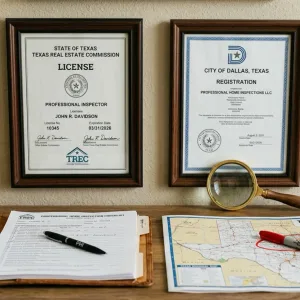
One of the most important things to understand is that both local independent inspectors and national franchise inspectors operating in Texas are regulated by the same authority: the Texas Real Estate Commission (TREC). The licensing baseline is identical for both. This matters because it means the minimum standard of competence is the same — and it also means that “franchise” doesn’t automatically equal “more regulated” or “more accountable.”
The highest TREC license tier — Professional Inspector — requires 1,290 hours of education, 250 supervised inspections, and passing both national and state exams. All TREC-licensed inspectors must complete 16 hours of continuing education every two years to maintain their license. Both local and franchise inspectors must carry minimum Errors and Omissions (E&O) insurance and General Liability insurance of at least $100,000 per occurrence.
TREC’s Standards of Practice mandate a non-invasive visual inspection of structural elements, electrical systems, HVAC, plumbing, roofing, and other major systems. What’s explicitly excluded: areas not readily accessible, cosmetic items, code compliance (unless tied to a functional defect), environmental hazards like asbestos or lead paint, and geological or soil stability assessment. Understanding these boundaries helps set realistic expectations regardless of who you hire.
To verify a home inspector’s TREC license and check their standing, use the License Holder Search tool at trec.texas.gov. This takes about two minutes and should be a non-negotiable step before hiring anyone.
How to Verify Any Inspector’s Credentials (Local or Franchise)
Here’s a practical step-by-step process that applies equally to local and franchise inspectors:
- Go to trec.texas.gov → “License Holder Search” → Enter name or license number
- Verify “Active” status and check for any “Disciplinary Actions” history
- Confirm E&O and General Liability insurance coverage — ask for proof, not just a verbal confirmation
- Ask for the specific inspector’s years of experience in DFW and their prior trade background
- Request a sample inspection report to assess thoroughness, photo quality, and communication style
- Check Google and Yelp reviews specifically for the individual inspector or local office — not just the brand
⚠️ Don’t Fall for These Common Inspector Red Flags
Avoid any inspector — local or franchise — who can’t produce their TREC license number on request, won’t provide proof of E&O insurance, refuses to share a sample report, or rushes through inspections in under 90 minutes on a typical-sized home. Quality inspectors take two to four hours on-site, produce detailed photo-rich reports, and are completely transparent about their credentials. If an inspector seems annoyed by your questions, that’s your answer.
Local vs. National: Head-to-Head Comparison on Key Decision Factors
Here’s how local independent inspectors and national franchise services compare across the factors that matter most to DFW homebuyers. This is based on research data, consumer reviews, and real-world market observations — not marketing claims from either side.
| Decision Factor | Local Independent Inspector | National Franchise |
|---|---|---|
| Inspection Thoroughness | High — more time per inspection, driven by personal reputation | Good — standardized checklists; risk of checkbox mentality at high volume |
| Local DFW Expertise | Superior — deep knowledge of clay soil, hail, aging systems, regional eras | Variable — national training may lack DFW-specific depth |
| Report Quality | Detailed, narrative-driven, photo-rich, personalized | Consistent format, clear summaries; sometimes less narrative depth |
| Pricing | Often $50–$150 less; flexible bundling of ancillary services | Higher due to franchise overhead; more rigid pricing structure |
| Accountability | Direct and personal — entire livelihood depends on client satisfaction | Distributed — primarily local franchisee; corporate involvement varies |
| Communication | Highly personalized — same person from booking through post-closing | May involve multiple contacts; more standardized messaging |
| Availability | Can book up quickly in peak season (April–July) | Higher availability — multiple inspectors, faster scheduling |
| Google Reviews | 4.9–5.0 stars typical for well-established local inspectors | 4.5–4.9 stars typical for DFW franchise offices |
For most DFW buyers prioritizing DFW home inspection expertise and local knowledge, the local independent model consistently offers a stronger combination of thoroughness, regional depth, and direct accountability. But the right choice ultimately depends on your specific priorities — and we’ll address that directly in the decision checklist below.
DFW-Specific Challenges: Where Local Expertise Makes the Biggest Difference
This is where the local-vs.-franchise debate stops being theoretical and becomes concrete. The Dallas-Fort Worth market has a specific set of inspection challenges that require genuine regional knowledge — not just a national checklist applied to a Texas address.
Expansive Clay Soil Foundation Movement. DFW sits on some of the most expansive clay soil in the country. This soil swells dramatically when wet and contracts when dry, creating constant pressure on foundations regardless of their age or type. The result is foundation movement — cracks, shifting, drainage problems — that can range from cosmetic to catastrophic. An experienced local inspector recognizes the specific crack patterns that indicate active movement versus settled cracks, understands which drainage configurations accelerate the problem, and knows the regional repair methods and their typical cost ranges. Understanding foundation issues and expansive clay in North Texas is a specialized skill built over years of local inspections — not something covered adequately in a national training curriculum.
Hail and Storm Damage. North Texas experiences some of the most frequent and severe hail in the United States. Local inspectors develop pattern recognition for impact marks on different roofing materials — asphalt shingles, metal, tile — and understand the DFW-specific damage profiles that result from the region’s hail size and frequency. A franchise inspector following a generic hail checklist may document obvious damage while missing the subtler signs of granule loss, bruising, and underlayment compromise that will lead to leaks and premature failure within a few years.
Aging Galvanized Plumbing and Aluminum Wiring. Fort Worth homes built in the 1960s and 1970s frequently have galvanized steel pipes and aluminum branch circuit wiring — both systems with well-documented failure modes that require specific knowledge to evaluate. Galvanized pipes corrode from the inside out, restricting water flow and eventually failing entirely. Aluminum wiring, when improperly connected or modified, creates fire hazards. A local inspector who has evaluated hundreds of homes from this era knows exactly what to look for and how to communicate the risk level to buyers. This isn’t knowledge you get from a training manual — it’s pattern recognition built through years of DFW-specific field experience.
Extreme Heat Effects on HVAC and Roofing. DFW regularly exceeds 100°F for extended periods during summer. This places extraordinary stress on HVAC systems, accelerating wear on components and exposing undersized or improperly maintained systems. It also dramatically accelerates roof deterioration, particularly on south- and west-facing slopes. Local inspectors understand the specific wear patterns, sizing issues, and maintenance failures that DFW’s climate produces — and they know how to evaluate HVAC system condition and maintenance history in the context of the region’s extreme demands.
Regional Building Code Variations. DFW’s building codes have evolved across decades, and different municipalities within the metroplex have adopted and enforced codes differently. Local inspectors understand how older and newer codes apply to specific neighborhoods and construction eras — knowledge that helps them distinguish between a code deficiency that represents a real safety risk and one that simply reflects the standards of the time the home was built.
Ready to schedule a home inspection with an inspector who understands DFW’s unique challenges? Journey Home Inspections’ services are built specifically around the issues that matter most in North Texas — from expansive clay foundations to hail-damaged roofs.
🔍 Local Expertise Isn’t Just About Location — It’s About Deep Knowledge
A truly local DFW inspector has years of hands-on experience with the region’s unique soil, climate, construction eras, and building practices. They understand why a particular crack pattern indicates active foundation movement, which roofing materials are most vulnerable to North Texas hail, and how DFW’s extreme heat affects HVAC systems differently than in other climates. A franchisee who recently relocated to DFW — even with thorough corporate training — may lack this depth of pattern recognition. When evaluating any inspector, ask specifically how long they’ve been inspecting homes in DFW and what their background was before inspection work.
Top Home Inspectors in DFW: Local Leaders Compared and Reviewed
Here’s an honest look at the major inspection providers operating in the DFW market — both local and franchise — so you can make a fully informed comparison.
Journey Home Inspections
- Type: Local independent home inspector
- Location: Fort Worth, TX
- Service Area: Dallas-Fort Worth Metroplex, including Fort Worth, Weatherford, Justin, Eagle Mountain, Roanoke, Southlake, Westlake, Argyle, Trophy Club
- Specialties: Expansive clay foundation assessment, hail damage identification, aging plumbing and wiring evaluation, DFW-specific construction era knowledge
- Qualifications: TREC Professional Inspector license, ASHI/InterNACHI certifications, 5–20+ years of trade experience
- Reporting: Detailed, photo-rich reports (30–60+ pages) using professional software, delivered within 24 hours
- Pricing: Mid-range ($500–$650 for a typical home), flexible ancillary service packages, often $50–$150 less than comparable franchise services
- Differentiators: Deep local expertise in DFW-specific challenges, personalized client relationships from booking through post-closing, direct accountability, flexible customization for each property’s unique risk profile
Learn more about Journey Home Inspections’ DFW home inspection services and what sets this local approach apart from standardized franchise offerings.
Pillar To Post
- Type: National franchise
- Service Area: Multiple DFW locations and nationwide presence
- Specialties: Standardized inspection protocols, consistent reporting format, broad training across all home systems
- Qualifications: Franchisees and inspectors meet TREC minimums; many hold ASHI/InterNACHI certifications
- Reporting: Proprietary software with consistent branding, clear summaries, standardized format
- Pricing: Generally $550–$700+ for a typical home, rigid pricing structure, pre-defined ancillary packages
- Differentiators: Strong national brand recognition, high availability, standardized processes, corporate backing. Local expertise varies significantly by individual franchisee.
For a detailed side-by-side review, see HouseMaster vs. Pillar To Post inspector reviews and pricing in the DFW market.
HouseMaster
- Type: National franchise
- Service Area: Multiple DFW locations and nationwide presence
- Specialties: Established franchise with consistent training, focus on customer service and detailed reporting
- Qualifications: Franchisees and inspectors meet TREC minimums; training emphasizes thoroughness and customer communication
- Reporting: Detailed reports with clear organization, though format and depth can vary by individual franchisee
- Pricing: Mid-to-high range ($550–$700+), standardized pricing with limited flexibility
- Differentiators: Long-standing franchise with a reputation for quality and emphasis on client communication. As with all franchises, local expertise depends heavily on the specific franchisee’s background and tenure in DFW.
WIN Home Inspection
- Type: National franchise
- Service Area: Multiple DFW locations and nationwide presence
- Specialties: Technology-forward approach, proprietary inspection software, standardized checklists, digital integration with real estate platforms
- Qualifications: Franchisees and inspectors meet TREC minimums; emphasis on technology training
- Reporting: Digital reports with consistent formatting, integration with real estate transaction platforms
- Pricing: Mid-to-high range ($550–$700+); technology surcharges may apply depending on services selected
- Differentiators: Strong emphasis on technology and digital integration, quick scheduling. DFW-specific expertise varies by franchisee; technology investment does not substitute for regional knowledge.
National Property Inspections (NPI)
- Type: National franchise
- Service Area: Multiple DFW locations and nationwide presence
- Specialties: Standardized inspection protocols, corporate training programs, consistent quality across franchises
- Qualifications: Franchisees and inspectors meet TREC minimums; corporate training programs provide baseline consistency
- Reporting: Standardized reports with clear formatting, proprietary software
- Pricing: Mid-range ($500–$650+), standardized pricing structure
- Differentiators: Established franchise with corporate backing and consistent service delivery. High availability is a genuine strength. Local DFW expertise depends on individual franchisee background.
If you’ve reviewed the options and want to work with an inspector who brings deep local DFW expertise, direct accountability, and flexible service packages, read what Journey Home Inspections clients say about their experience — then reach out when you’re ready.
Frequently Asked Questions About Local vs. Franchise Home Inspectors in DFW
Is the inspector who shows up at a national franchise actually experienced, or are they often newly trained employees?
It varies significantly, and this is one of the most important questions to ask before booking. Many franchise operations employ a mix of experienced inspectors and newer, recently licensed individuals who are still building field experience under the franchise’s training protocols. While they meet TREC’s licensing minimums, the specific inspector assigned to your home might have considerably less hands-on experience than a seasoned independent inspector who has been working DFW properties for a decade or more. Always ask directly: how long has this specific inspector been performing home inspections in DFW, and what was their professional background before inspection work? A franchise brand name doesn’t answer that question — only asking does.
Do local independent inspectors carry adequate insurance compared to a large franchise’s corporate backing?
Yes — and this is a common misconception worth clearing up. All TREC-licensed inspectors in Texas, whether local or franchise, are required to carry minimum Errors and Omissions (E&O) insurance and General Liability insurance of at least $100,000 per occurrence. A reputable local independent inspector will have their own robust policy, directly tied to their personal business. While a franchise may have a corporate umbrella policy, you primarily deal with the local franchisee’s individual policy when a claim arises — the corporate brand’s involvement in individual claims varies significantly by franchise agreement. Always ask any inspector, local or franchise, for proof of their current E&O and General Liability coverage before hiring them.
How can I verify any inspector’s actual track record and experience beyond just brand name recognition?
Start at trec.texas.gov — use the License Holder Search to confirm their license type (Professional Inspector is the highest tier), verify “Active” status, and check for any disciplinary actions history. Then go to Google and Yelp to read reviews specifically for the individual inspector or local office, not just the brand. Ask about their years of experience inspecting homes in DFW specifically, their prior trade background, and any additional certifications beyond TREC minimums (ASHI, InterNACHI). Finally, request a sample inspection report — this is the single best indicator of how thorough, clear, and useful their work actually is. A brand name tells you very little; a sample report tells you almost everything.
Do real estate agents steer buyers toward franchise inspectors for convenience reasons, even if a local inspector might be better?
Some do, and it’s worth understanding why. Agents sometimes prefer franchise inspectors because of standardized scheduling systems, consistent branding, and the perceived reliability of a national name — all of which can make a busy transaction feel smoother. While TREC prohibits kickbacks or referral fees between agents and inspectors, agents can still recommend inspectors based on convenience or familiarity rather than pure quality. Your agent’s recommendation is a useful starting point, but it should be the beginning of your research, not the end. You have the right — and the responsibility — to choose the inspector you’re most confident in, based on credentials, experience, and fit for your specific property.
Are franchise inspection reports more detailed or easier to understand than local inspector reports?
Franchise reports are often standardized with consistent branding and a clear, navigable layout, which can make them easy to work through. However, “detailed” and “easy to understand” ultimately depend on the individual inspector, not the brand. Many local independent inspectors use cutting-edge platforms like Spectora or HomeGauge to produce highly detailed, photo-rich, narrative-driven reports that are equally or more comprehensive than standardized franchise formats — and often more personalized to your specific property’s issues. The best way to compare is to request sample reports from any inspector you’re considering, local or franchise, before you book. The report is the deliverable — evaluate it directly.
Does a local inspector have the same advanced technology (thermal imaging, drones) as a national franchise?
Yes — and this is another common misconception. Many reputable local independent inspectors in DFW invest heavily in advanced technology, including thermal imaging cameras for detecting moisture intrusion and electrical hot spots, drones for safe and thorough roof inspections, moisture meters, gas leak detectors, and professional digital reporting software. Access to advanced technology is not a franchise exclusive — it’s a choice made by individual inspectors based on their commitment to comprehensive service. When evaluating any inspector, ask specifically what technology they use and how it’s incorporated into the inspection process. You can also review how Journey Home Inspections approaches roof inspections to understand what a thorough, technology-informed process looks like in practice.
Making Your Decision: A Checklist for Choosing the Right Inspector for Your DFW Home
You’ve now seen the full picture — the regulatory framework, the pricing realities, the regional challenges, the provider landscape, and the honest trade-offs between local and franchise models. Here’s a practical checklist to guide your final decision, regardless of which direction you’re leaning.
- Verify TREC license status and check for disciplinary actions at trec.texas.gov
- Confirm E&O and General Liability insurance coverage — ask for written proof
- Ask about the specific inspector’s years of experience in DFW and their prior trade background
- Request a sample inspection report to assess thoroughness, photo quality, and communication style
- Check Google and Yelp reviews specifically for the individual inspector or local office
- Ask about their experience with your home’s specific age, foundation type, and any known issues
- Inquire about ancillary services (WDI, sewer scope, pool, sprinkler) and whether they offer bundled packages
- Confirm report turnaround time — 24 hours is standard for reputable inspectors
- Ask if they offer a post-inspection walk-through or phone consultation to explain findings
- For franchise inspectors, ask specifically about the individual franchisee’s local DFW experience and tenure
When you’re ready to move forward, schedule a home inspection with Journey Home Inspections and experience firsthand what a locally-rooted, deeply experienced DFW inspector actually looks like in practice. You can also explore the different types of inspections offered to understand which services make sense for your specific property.
The Bottom Line: Local Expertise vs. National Standardization in DFW
After working through all of this data, the conclusion is more nuanced than “local is always better” or “franchise is always safer.” Both models have genuine strengths. Both must meet the same TREC licensing and insurance baseline. Both can produce thorough, useful inspections when the right inspector is doing the work.
But in the DFW market specifically, the evidence consistently points toward local independent inspectors as the stronger choice for most buyers — particularly those purchasing older homes, properties in high-clay-soil areas, or homes with complex systems. The regional knowledge gap is real. The accountability structure is more direct. The pricing is typically more competitive. And the personalized communication model — where the same experienced person handles your inspection from booking through post-closing — creates a level of continuity and trust that a distributed franchise operation structurally can’t replicate.
Franchise inspectors offer real advantages in availability and standardization — and for buyers in competitive transactions who need same-week scheduling, or who are purchasing newer construction where DFW-specific regional knowledge is less critical, a reputable franchise can absolutely do the job. The key word in both cases is “reputable.” Verify credentials, review sample reports, check individual inspector reviews, and ask the right questions. Brand name — local or national — is never a substitute for that due diligence.
“The inspection fee is the smallest cost in a home purchase. The real cost is what gets missed.”
According to 2024 NAR data, home inspections lead to price negotiations, repair credits, or transaction cancellations that save buyers money in 70 to 85 percent of cases. That’s an extraordinary return on a $500 to $650 investment. The inspection isn’t a formality — it’s the mechanism by which you find out what you’re actually buying. Make sure the person doing it knows what they’re looking at.
Protect Your DFW Home Investment with a Thorough, Expert Inspection
Buying a home in North Texas is one of the biggest financial decisions you’ll ever make. You deserve an inspector who understands the specific challenges of DFW’s clay soil, hail exposure, aging housing stock, and extreme climate — not someone following a national checklist designed for a different market.
Journey Home Inspections brings deep local expertise, direct accountability, and a genuine commitment to helping you understand exactly what you’re buying — before you close. Serving Fort Worth, Weatherford, Justin, Eagle Mountain, Roanoke, Southlake, Westlake, Argyle, Trophy Club, and the greater DFW Metroplex.