Key Takeaways
- Home inspectors in Texas can only report a “mold-like substance” — only a TDLR-licensed Mold Assessment Consultant can legally test, confirm, and define the extent of a mold problem.
- Mold remediation costs in DFW range from $500 for minor surface mold to $30,000+ for systemic infestations — knowing the tier you’re dealing with is critical before negotiating with a seller.
- North Texas clay soil, summer humidity, and aging housing stock make water intrusion findings extremely common — over 60% of inspection reports for homes older than 20 years note evidence of past or present moisture.
- Your option period (typically 7–10 days) is the most powerful tool you have as a buyer — use it to hire a licensed mold assessor, get written quotes, and negotiate repairs or credits before you’re legally committed.
- Trust Journey Home Inspections for thorough, same-day inspections that catch water damage and mold-like substances early — visit Journey Home Inspections to protect your investment before you close.
What Do Mold and Water Damage Inspection Findings Really Mean for Your Home Purchase?
Mold and water damage findings during a home inspection can range from minor cosmetic issues to serious structural problems requiring thousands of dollars in remediation. The key is understanding what the inspector found, whether it requires specialist evaluation, and how to negotiate with the seller. This guide walks you through every scenario so you can make a confident decision.
Let’s break down what these findings actually mean, what they’ll cost to fix, and how to protect yourself during the option period.
Journey Home Inspections
Same-Day Detailed Report — 4,000+ Items Checked
Core Service Programs:
- Buyer & Seller Home Inspections for pre-purchase, pre-listing, and full general inspections covering 4,000+ items
- New Construction & Phase Inspections for new builds, phase checks, and 11-month builder warranty inspections
- Specialty Inspections for pool & spa, septic, well, irrigation, and pier & beam foundation systems
Why Choose Journey Home Inspections:
- ✓ Trusted by customers with a perfect 5.0-star Google rating across 88 verified reviews
- ✓ Family-owned, faith-based, and serving North Texas since 2016
- ✓ Led by Bryan Hughes — TREC-licensed (#21772) and insured
- ✓ InterNACHI Certified Professional Inspector
- ✓ 4,000+ items checked on every inspection — roof to foundation
- ✓ Same-day reports with photos, clear findings, and plain-language explanations
- ✓ Thermal imaging and drone technology on every inspection
Understanding “Mold-Like Substance” vs. Confirmed Mold
When your home inspector writes “mold-like substance” in their report, that’s not vague language — it’s the legally required language under Texas law. A TREC-licensed home inspector is authorized to observe and report on “readily visible evidence of water penetration” or a “mold-like substance,” but they are explicitly prohibited from taking samples or definitively identifying mold. That distinction matters enormously for what happens next.
Only a Texas-licensed Mold Assessment Consultant, regulated by the Texas Department of Licensing and Regulation (TDLR), can legally perform testing, analyze lab results, and confirm whether a substance is actually mold — and what species and concentration you’re dealing with. If your inspector flags anything suspicious, your next call during the option period should be to a TDLR-licensed assessor, not a remediation company.
A “mold-like substance” finding is a red flag that warrants specialist investigation — not an automatic deal-killer. Many buyers panic and walk away from homes that have a manageable, well-contained issue. Others make the opposite mistake and dismiss the finding without investigating further. Neither extreme serves you well. The right move is to get the data, then decide.
You’re Not Alone — Water Damage Is Common in DFW
Over 60% of inspection reports for homes older than 20 years in North Texas note evidence of past or present water intrusion. This is not a reflection on you as a buyer; it’s a reflection of our clay soil, humidity, and aging housing stock. The key is catching it early.
Water Damage: The Root Cause You Need to Identify
Mold doesn’t appear out of nowhere. It needs moisture, an organic surface, and time. In the DFW area, the conditions that create water intrusion are baked into the region’s geology and climate. North Texas’s expansive clay soil is notorious for shifting with seasonal moisture changes — that movement stresses foundations, cracks slabs, and breaks plumbing lines running beneath them. A slow slab leak can saturate the subfloor for months before anyone notices, creating ideal mold conditions inside wall cavities and under flooring.
Summer humidity compounds the problem. Poorly ventilated attics and crawl spaces trap warm, moist air, and condensation forms on cooler surfaces — wood framing, insulation, and ductwork. Without adequate airflow, that moisture feeds mold colonies that can go undetected for years. Homes in desirable Fort Worth neighborhoods like Ridglea, the TCU area, and Ryan Place — many built between the 1940s and 1970s — often have original plumbing, minimal insulation, and decades of deferred maintenance that make them especially vulnerable.
Water stains on ceilings, walls, or floors are the visible evidence of this process. A stain tells you moisture was present; it doesn’t tell you whether the source has been fixed or whether mold has already begun growing on the other side of that drywall. That’s exactly why a thorough general home inspection is your first line of defense — and why specialist follow-up is often warranted.
The True Cost of Mold and Water Damage in DFW
| Cost Category | Typical DFW Range | Notes |
|---|---|---|
| Minor surface mold remediation | $500 – $1,500 | Small, contained areas (under sink, bathroom corner) |
| Cavity mold remediation | $2,000 – $6,000 | Inside wall cavity; requires drywall and insulation removal |
| Systemic mold remediation | $10,000 – $30,000+ | Multiple rooms or HVAC system involvement |
| Air quality testing | $350 – $600 | Includes outdoor control samples + 2–3 indoor samples |
| Surface sampling (per sample) | $100 – $200 | Swab or tape lift with lab analysis |
| Full mold assessment | $500 – $1,500+ | Visual inspection, moisture mapping, testing plan |
| Source repair (foundation, plumbing, roof) | $1,000 – $15,000+ | Remediation without fixing the source always fails |
| Texas insurance mold coverage cap | Up to $5,000 | Only if mold results from a covered peril (e.g., sudden pipe burst) |
| Resale value reduction (disclosed mold history) | 10% – 25% | National data; unremediated issues carry the greatest stigma |
Standard Texas homeowners insurance policies severely limit mold coverage — typically capping payouts at $5,000 and only when mold results from a sudden, covered peril like a burst pipe. Gradual leaks, humidity-related growth, and poor maintenance are almost never covered. That means your true financial exposure as a buyer could include remediation, source repair, temporary housing during the work, and a permanent reduction in resale value. Understanding these numbers before you negotiate is what separates a confident buyer from one who gets blindsided after closing.
When to Hire a Mold Specialist During Your Option Period
If your home inspector reports any of the following — mold-like substance, elevated moisture readings, water stains, evidence of past water intrusion, or musty odors — treat it as a signal to bring in a licensed Texas Mold Assessor during your option period. This is not an overreaction; it’s standard practice for informed DFW buyers.
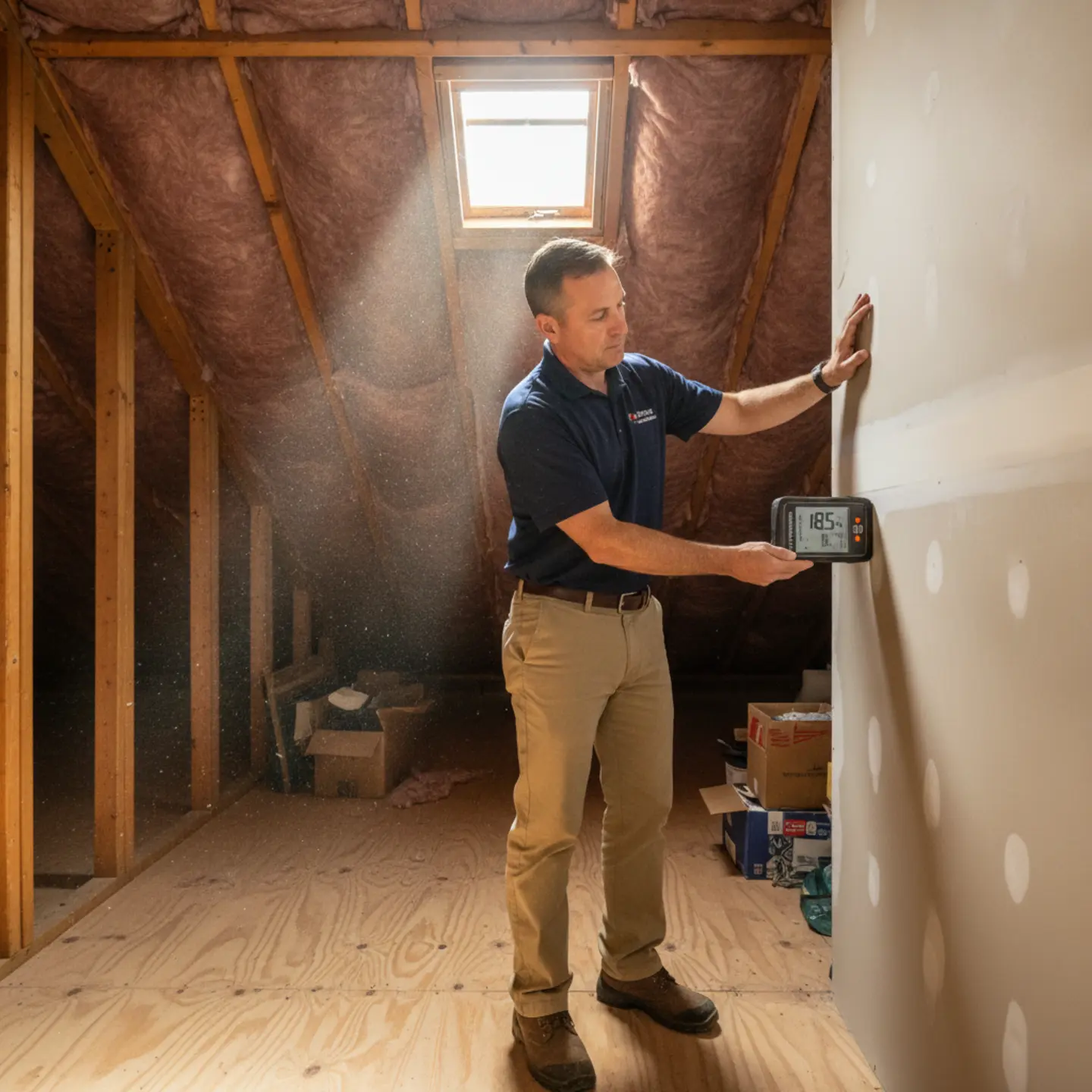
A licensed mold assessor brings tools a general inspector doesn’t carry: thermal imaging cameras that detect temperature differentials caused by hidden moisture behind walls and ceilings, and calibrated moisture meters that can map the extent of water damage without cutting into drywall. The result is a detailed, data-backed picture of what’s actually happening inside the home — not just what’s visible on the surface. For homes with pier and beam foundations, which are common in older Fort Worth neighborhoods, this kind of moisture mapping is especially valuable given how water can pool beneath the structure.
One critical protection Texas law provides: the same company cannot legally perform both the mold assessment and the mold remediation on the same project. This separation of powers exists specifically to prevent a conflict of interest where an assessor inflates findings to sell a more expensive cleanup job. When you hire an independent assessor, their only incentive is accuracy — and that gives you a report you can actually trust at the negotiating table.
Red Flags and How to Protect Yourself
The “Free Inspection” Trap
Beware of restoration companies offering free mold inspections and then immediately providing a quote for their own remediation work. This is a conflict of interest. Always hire an independent, licensed Mold Assessment Consultant with no financial stake in the remediation outcome.
The mold industry has a well-documented problem with unscrupulous operators. The most common scheme: a restoration company offers a “free” mold inspection, finds alarming results, and immediately presents a quote for their own remediation services — often at inflated prices. Under Texas law, this arrangement is actually illegal when the same entity performs both the assessment and the remediation. If a company offers both services on the same job, that’s a hard stop — walk away.
Before hiring any mold professional, verify their license at tdlr.texas.gov/licensesearch/. A Mold Assessment Consultant license from TDLR is the non-negotiable credential in Texas. No license, no hire — full stop. The EPA also recommends against DIY bleach remediation for any mold issue larger than 10 square feet or any situation where mold is suspected inside a wall cavity. Bleach kills surface mold on non-porous materials but is ineffective on drywall and wood, which means you’re masking the problem rather than eliminating it.
Finally, understand that proving a seller knew about mold and failed to disclose it after closing is extremely difficult and expensive under Texas law. The Seller’s Disclosure Notice requires sellers to report known defects, but “known” is the operative word — and proving intent is a legal battle most buyers lose. This is why pre-closing inspection and specialist evaluation are your most powerful protections. Learn more about common home inspection questions to go into the process fully prepared.
Negotiating with the Seller: Your Option Period Playbook
Use Your Option Period Strategically
The option period (typically 7–10 days) is your legal window to hire specialists, request repairs, negotiate credits, or walk away. Don’t waste it. If the inspector flags water damage or mold-like substance, hire a mold assessor immediately so you have concrete data before the deadline.
The option period is the most powerful tool a Texas buyer has, and most people underutilize it. Once you have a licensed assessor’s report and written remediation quotes from licensed contractors, you’re negotiating with facts — not feelings. That changes the entire dynamic with a seller.
For minor, contained issues — small surface mold, a single isolated leak — request that the seller pay 100% of the remediation cost before closing. For more significant problems, a common and effective strategy is to negotiate a credit equal to 1.5 times the remediation quote. That buffer accounts for unforeseen complications that almost always arise once walls are opened. Never negotiate based on verbal estimates; get everything in writing from licensed contractors so the seller has no room to dispute your numbers.
If the seller refuses to address a major mold or water damage issue, you have a clear legal right in Texas to terminate the contract during the option period and recover your earnest money. That’s not a threat — it’s a protection built into the process specifically for situations like this. A home with serious, unaddressed water damage or systemic mold is not a bargain at any price; it’s a liability. Knowing when to walk away is just as important as knowing how to negotiate. Review the full scope of what a home inspection covers so you understand exactly what data you’ll have in hand before that conversation begins.
Why Journey Home Inspections Is the Right Choice for DFW Homebuyers
When mold and water damage findings are on the line, the quality of your inspection report determines everything that follows — your negotiating position, your specialist referrals, your ability to make an informed decision before the option period expires. Journey Home Inspections was built specifically to give DFW buyers that level of clarity.
With a perfect 5.0-star Google rating across 88 verified reviews, Journey Home Inspections has earned its reputation through consistent, thorough work — not marketing. Led by TREC-licensed inspector Bryan Hughes (#21772) and InterNACHI Certified, the team checks 4,000+ items per inspection and delivers same-day reports with photos and plain-language explanations. Thermal imaging and drone technology are included on every inspection, which means hidden moisture behind walls and on rooflines gets flagged — not missed.
Family-owned and faith-based since 2016, Journey Home Inspections operates on a simple principle: your peace of mind matters more than upselling. When water damage or a mold-like substance is found, the report gives you the precise data you need to hire a specialist, negotiate with confidence, or walk away — without pressure and without guesswork. That’s the standard every DFW buyer deserves, whether you’re purchasing in Fort Worth, Weatherford, Southlake, Trophy Club, or anywhere across the metroplex.
Frequently Asked Questions
This is the legally required language for a Texas home inspector who is not a licensed mold assessor — it means they observed something that looks like mold but cannot legally identify it. You should take this finding seriously and use your option period to hire a TDLR-licensed Mold Assessment Consultant to investigate further. The assessor will determine whether it is actually mold, what species is present, and how far the problem extends — giving you the data you need to negotiate or walk away with full knowledge of the situation.
A water stain is the discoloration left behind by moisture — evidence that a leak occurred at some point, past or present. Mold is a living fungus that grows on organic surfaces when moisture is available, often appearing black, green, or white with a fuzzy or textured surface. The two are related: water stains create the conditions mold needs to grow, and mold frequently develops on top of existing stains. Only a surface sample analyzed by a certified lab can definitively confirm whether what you’re seeing is mold, which is why a licensed assessor’s evaluation is the only reliable answer.
It is strongly recommended, especially when you’re still inside your option period. A general home inspector identifies the presence of moisture but cannot determine whether mold has already begun growing inside a wall or ceiling cavity, or how far the water damage has spread. A licensed mold assessor uses thermal imaging cameras and calibrated moisture meters to map hidden water damage with precision and can produce a remediation protocol that tells contractors exactly what needs to be removed and replaced. That report is also your most effective negotiating tool with the seller.
The EPA and professional remediators generally advise against bleach as a mold solution, and here’s why: bleach can kill surface mold on non-porous materials like tile, but it is ineffective on porous materials like drywall and wood framing — the materials most commonly affected in a home. It also does not address the moisture source, so the mold returns. For any mold issue larger than approximately 10 square feet, or any situation where mold is suspected inside a wall cavity, hiring a TDLR-licensed Mold Remediation Contractor is the only approach that ensures the problem is fully and safely resolved.
Journey Home Inspections holds a perfect 5.0-star Google rating across 88 verified reviews — a track record built on inspections that catch what others miss. Led by TREC-licensed inspector Bryan Hughes (#21772) and InterNACHI Certified, the team checks 4,000+ items per inspection and delivers same-day reports with photos and clear, plain-language findings. Thermal imaging and drone technology are included on every inspection, so hidden moisture and roof issues don’t slip through. Family-owned and faith-based since 2016, Journey Home Inspections prioritizes your informed decision-making over upselling — giving you the data you need to negotiate, hire specialists, or walk away with confidence. Schedule your home inspection with Journey Home Inspections and get the clarity you need before your option period expires.
Facing Mold or Water Damage Findings on a DFW Home?
You deserve a clear, honest picture of what you’re buying — not a report that leaves you guessing. Journey Home Inspections delivers same-day, 4,000+ item inspections with thermal imaging that flags water damage and mold-like substances before you’re legally committed. Get the data you need to negotiate with confidence or walk away with your earnest money intact.
*Pricing, service availability, and inspection details mentioned in this article are accurate as of the date of publication and are subject to change. A home inspection reflects a property’s condition at the time of inspection and is not a warranty or guarantee. Please contact us directly to schedule an inspection of your specific property.