Key Takeaways
- Soil at the foundation brick line is a significant defect—not a cosmetic one—that traps moisture against your foundation, creates a hidden entry point for subterranean termites, and can trigger wood rot, mold, and costly foundation movement if left unaddressed.
- In DFW’s expansive Blackland Prairie and Cross Timbers clay soils, proper foundation clearance is especially critical: an estimated 70–90% of homes on these soils will experience some degree of foundation movement over their lifespan, and uneven moisture distribution is the primary driver.
- Proactive grading correction typically costs $300–$2,500—a fraction of the $5,000–$25,000+ in foundation repairs, plus termite damage, wood rot, and mold remediation costs that can accumulate within 3–5 years of ignoring this finding.
- In a Texas real estate transaction, soil at the brick line is a negotiable defect during the option period; buyers commonly request a seller credit, price reduction, or completed repair before closing—and FHA/VA lenders may require remediation before the loan can fund.
- Trust Journey Home Inspections for thorough, honest DFW home inspections backed by a perfect 5.0-star Google rating and 4,000+ items checked — visit Journey Home Inspections to protect your next home purchase.
What Does It Mean When a Home Inspector Finds Soil at the Foundation Brick Line?
Soil at the foundation brick line is a significant defect that traps moisture against your home’s foundation, creating a direct pathway for termites and risking foundation movement, wood rot, and mold. This isn’t a cosmetic issue—it’s a conducive condition for serious, costly damage. The good news is that remediation is typically straightforward and far less expensive when addressed proactively than when damage has already occurred.
Understanding what this finding really means, why it matters in North Texas’s expansive clay soil environment, and what your options are will help you make an informed decision about your home.
Journey Home Inspections
Same-Day Detailed Report — 4,000+ Items Checked
Core Service Programs:
- Buyer & Seller Home Inspections for pre-purchase, pre-listing, and full general inspections covering 4,000+ items
- New Construction & Phase Inspections for new builds, phase checks, and 11-month builder warranty inspections
- Specialty Inspections for pool & spa, septic, well, irrigation, and pier & beam foundation systems
Why Choose Journey Home Inspections:
- ✓ Trusted by customers with a perfect 5.0-star Google rating across 79 verified reviews
- ✓ Family-owned, faith-based, and serving North Texas since 2016
- ✓ Led by Bryan Hughes — TREC-licensed (#21772) and insured
- ✓ InterNACHI Certified Professional Inspector
- ✓ 4,000+ items checked on every inspection — roof to foundation
- ✓ Same-day reports with photos, clear findings, and plain-language explanations
- ✓ Thermal imaging and drone technology on every inspection
Why Soil at the Foundation Brick Line Is a Problem
Your Concern Is Valid
Finding soil at the foundation brick line can feel overwhelming, especially if you’re in the middle of a real estate transaction. This is a real issue that deserves attention—but it’s also one of the most common findings in DFW home inspections, and it’s almost always fixable.
When soil builds up against your home’s foundation to the point where it reaches or exceeds the bottom of the brick veneer or siding, it eliminates a critical buffer zone that your home depends on. That buffer isn’t just empty space—it’s a drainage gap, a termite inspection corridor, and a moisture barrier all in one.
Here’s what happens when that clearance is lost. Moisture from rain, irrigation, and normal soil saturation has nowhere to drain away from the foundation—it pools and lingers against the masonry and framing. Over time, that persistent moisture creates the conditions for wood rot in sill plates and wall studs, mold growth inside wall cavities, and the kind of uneven moisture distribution that causes foundations to shift. Subterranean termites, which are extremely active throughout the DFW area, exploit high soil lines as a concealed highway directly into your home’s wood structure—bypassing the visible foundation perimeter where their mud tubes would otherwise be spotted during a routine inspection. These problems don’t announce themselves. They compound quietly, and they get significantly more expensive the longer the underlying condition remains.
Foundation and grading-related findings are flagged in an estimated 40–60% or more of home inspections on pre-2000 construction in North Texas, according to local inspection industry data. This is a common finding—but common doesn’t mean minor.
The Specific Risks in DFW’s Expansive Clay Soil Environment
Not every region faces the same stakes when it comes to foundation grading, and North Texas is in a category of its own. Tarrant, Parker, and Denton counties sit on Blackland Prairie and Cross Timbers soils—two geological zones with very high shrink-swell potential. These aren’t just slightly problematic soils; they undergo dramatic volume changes as moisture levels fluctuate. When it rains, they swell. During a drought, they shrink and crack. That cycle of expansion and contraction puts constant mechanical stress on your foundation.
According to Texas A&M AgriLife Extension research, an estimated 70–90% of DFW-area homes built on expansive soils will experience some degree of foundation movement over their lifespan. The primary driver of that movement isn’t the soil itself—it’s uneven moisture distribution around the foundation perimeter. When soil is piled high against one side of your foundation, that side stays wet while other areas dry out. The differential creates the rocking, heaving, and settling that leads to cracked slabs, sticking doors, and sloping floors.
Rapid growth in communities like Weatherford, Justin, Roanoke, and Argyle has also introduced a newer wrinkle: aggressive grading practices on infill and volume-build lots that prioritize maximizing usable space over long-term drainage performance. Homes built in these submarkets in the last 10–15 years can develop high-soil conditions faster than older homes in established Fort Worth neighborhoods, especially as landscaping matures and soil settles unevenly. If you’re buying in any of these areas, a thorough general home inspection that specifically evaluates exterior grading is not optional—it’s essential.
What Your Home Inspector Actually Observed
Pro Tip: Ask About the Clearance Measurement
When reviewing your inspection report, ask your inspector exactly how much clearance exists between the soil and the brick line. If they measured it using a level or tape measure, that’s a sign of a thorough inspection. Inspectors who use tools to document clearance are more likely to catch subtle grading issues early.
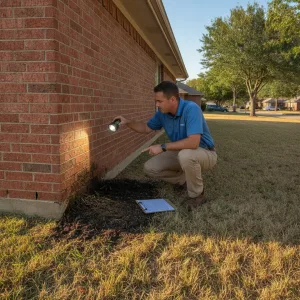
Your inspector performed a visual assessment of the exterior perimeter, evaluating the clearance between the finished grade—the actual soil surface—and the bottom edge of your brick veneer or siding. Building codes and widely accepted best practices, including the International Residential Code (IRC) and InterNACHI standards, require a minimum of 6 to 8 inches of clear space between grade and the bottom of any wood or masonry cladding. This gap ensures surface water drains away from the structure, allows for visual detection of termite mud tubes, and prevents direct wood-to-soil contact.
When your inspector noted that soil is at the brick line, they observed that this clearance is compromised or entirely eliminated. This is documented as a deficiency under the TREC Standards of Practice (Section 535.228), which requires licensed inspectors to report grading and drainage conditions that adversely affect the performance or integrity of the structure. This is not a judgment call or a matter of opinion—it’s an observable, measurable, reportable condition. The inspector’s job is to identify it; what happens next is up to you and the parties involved in the transaction.
For a deeper look at what inspectors are trained to flag during foundation evaluations in this region, the foundation inspection red flags specific to Fort Worth are worth reviewing before your next transaction.
The Real Costs: What Remediation Actually Costs
One of the most empowering things you can do with this inspection finding is put real numbers to it. Remediation for a high-soil condition is almost always far less expensive than buyers and sellers expect—and it’s a fraction of what deferred action costs down the road.
| Remediation Type | Typical Cost Range (DFW) |
|---|---|
| Basic re-grading (pulling soil back from foundation) | $300 – $800 |
| Extensive re-grading with drainage slope correction | $800 – $2,500 |
| French drain installation (subsurface drainage) | $1,500 – $5,000+ |
| Retaining walls (where slope or space requires) | $1,000 – $20,000+ |
| Gutter and downspout extensions (surface drainage) | $200 – $1,000 |
For the majority of homes where the issue is simply soil that has crept too high over time—through landscaping additions, mulch buildup, or soil erosion—basic re-grading is all that’s needed. A drainage contractor or landscaper can pull the soil back, reestablish the proper slope away from the foundation, and restore that critical 6–8 inch clearance for a few hundred dollars. More complex situations involving subsurface drainage problems or significant grade changes will fall toward the higher end of these ranges, but even then, you’re looking at a manageable investment compared to what comes next if the issue is ignored.
The Hidden Costs of Ignoring This Finding
The math on inaction is unambiguous. A grading correction that costs $300–$2,500 today can prevent a cascade of compounding damage that runs into the tens of thousands of dollars within 3–5 years on a DFW home.
Foundation repair is the biggest single risk. Differential foundation movement—the kind caused by uneven moisture distribution around the perimeter—is the leading cause of major foundation work in North Texas. Repair costs typically run $5,000–$25,000 or more depending on the number of piers required and the severity of movement. Termite damage remediation, including treatment and replacement of compromised wood framing, adds another $1,000–$10,000+. Wood rot in sill plates and wall studs—the direct result of persistent moisture contact—runs a similar range. Mold remediation, if moisture has penetrated wall cavities, can cost $3,000–$20,000+ on its own. And none of these figures account for the interior damage—drywall, flooring, trim—that often accompanies foundation movement and moisture intrusion.
These aren’t worst-case scenarios reserved for neglected properties. They’re the documented outcomes of a straightforward grading defect that was left unaddressed in North Texas’s uniquely demanding soil environment. Proactive correction at $300–$2,500 is one of the highest-ROI decisions a homeowner or buyer can make.
Your Options: Negotiation and Next Steps
Don’t Ignore This During Negotiation
If you’re a buyer and your inspector found soil at the brick line, don’t assume it’s a minor issue or that you can fix it yourself later. Bring it up during the option period and request remediation or a credit. Delaying this conversation or skipping it entirely can cost you thousands in foundation repairs down the road.
If you’re in a real estate transaction, you have real leverage here—and the DFW market’s shift toward more balanced conditions since 2023 means buyers are using inspection findings like this one more frequently and successfully than they could during the seller’s market years. During the option period, the most common approaches are a seller credit at closing (the most buyer-friendly option, since you control the contractor selection), a price reduction, or a repair escrow. Sellers sometimes prefer to remediate the issue themselves before closing to avoid deal complications, though buyers should be aware they’ll have less control over the quality of that work.
Lender requirements matter here too. FHA and VA loans have stricter property condition standards, and if a grading deficiency is severe enough to pose a health or safety risk—or if it has contributed to active water intrusion or foundation movement—the lender may require documented remediation before the loan can close. Conventional lenders are generally less prescriptive but will still flag active structural or moisture issues that affect habitability. If you’re buying as-is, this is exactly the kind of finding that makes a thorough inspection non-negotiable—as explored in detail in this guide on why as-is buyers still need a home inspection.
If you’re a current homeowner rather than a buyer, the calculus is simpler: address it now. Proactive correction protects your home’s value, keeps your foundation stable through North Texas’s drought-and-flood weather cycles, and eliminates a primary conducive condition for termite activity.
When to Call a Specialist: Structural Engineer vs. Drainage Contractor
Your home inspector’s role is to identify the deficiency and flag it for further action—not to engineer a solution or quantify structural damage. Knowing which specialist to call next depends on what the inspection report actually shows.
If the finding is isolated to the high soil line itself—no visible foundation cracking, no sticking doors, no sloping floors, no signs of active moisture intrusion—a drainage contractor or licensed landscaper is your first call. They can evaluate the grading, recommend the appropriate correction (re-grading, French drain, downspout extensions, or some combination), and perform the work. This is the most common scenario, and it’s resolved without an engineer.
If the inspection report also documents visible foundation cracks, settlement, differential elevation, or other signs that movement has already occurred, you need a licensed structural engineer (PE) before you do anything else. An engineer performs an elevation survey using precision instruments to quantify actual foundation movement across the slab, determines whether the movement is within acceptable tolerances or requires repair, and provides a written engineering opinion with specific repair recommendations. That opinion is what foundation repair contractors bid against—without it, you’re flying blind on scope and cost. Structural engineer consultations in DFW typically run $450–$800. It’s money well spent when the alternative is commissioning repair work without knowing what you actually need. For homes with pier-and-beam foundations, the evaluation process has additional considerations covered in Journey Home Inspections’ pier and beam foundation inspection services.
Why Journey Home Inspections Is the Right Choice for Your DFW Home Inspection
When a home inspector flags soil at the foundation brick line, the value of that finding depends entirely on how thoroughly it was evaluated and how clearly it’s explained. A vague note in a report doesn’t help you negotiate, plan, or protect yourself. A detailed finding with documented clearance measurements, photos, and a plain-language explanation of the risks—that’s what actually empowers you to make a confident decision.
Journey Home Inspections has earned a perfect 5.0-star Google rating across 79 verified reviews by delivering exactly that kind of inspection, consistently. Led by TREC-licensed inspector Bryan Hughes (#21772) and an InterNACHI Certified Professional Inspector, the team brings specialized knowledge of DFW’s expansive clay soil environment and the foundation and drainage issues it creates across Tarrant, Parker, and Denton counties. Every inspection covers 4,000+ items with same-day reporting, thermal imaging, and drone technology—so you’re not waiting days for answers when you’re in the middle of a transaction.
Family-owned and faith-based since 2016, Journey Home Inspections was built on the principle that honest, thorough assessments matter more than rushing through inspections or softening findings to keep a deal moving. When they find soil at the foundation brick line—or any other deficiency—you’ll receive a clear explanation of what it means, what the risks are, and what your options are. That’s the difference between an inspection report and an inspection that actually serves you. You can read what past clients have experienced on the Journey Home Inspections reviews page.
Frequently Asked Questions
It’s a significant concern, not just a cosmetic one. High soil at the foundation traps moisture against the structure, creating conditions for potential foundation movement, wood rot, and mold growth. It also provides a direct, concealed entry point for subterranean termites to access your home’s wood framing without leaving visible mud tubes on the exterior. This finding requires remediation—the only question is when and at what cost.
A high soil line by itself is usually not a deal-killer. In most transactions, it becomes a negotiation item during the option period, with buyers requesting a credit or remediation before closing. However, if the high soil has already caused significant foundation movement, active wood rot, or termite damage, it becomes part of a larger, more serious issue that can absolutely jeopardize the transaction. In DFW’s current balanced market, buyers have more leverage to address these findings than they did during the peak seller’s market years of 2020–2022.
A home inspector identifies the high soil line and documents its potential risks—that’s the scope of the TREC Standards of Practice. A structural engineer (PE) goes significantly further: they perform a precision elevation survey to quantify actual foundation movement across the slab, determine whether that movement is within acceptable tolerances or requires repair, and provide a written engineering opinion with a specific repair plan if needed. That engineering opinion is what foundation contractors bid against, and it’s essential if your inspection report shows any signs of existing foundation movement or structural impact.
In Texas, this is a negotiable item during the option period, and there’s no automatic legal obligation on either party. Because it’s a documented defect and a conducive condition for serious damage, buyers will typically request that the seller pay for remediation—either through a credit at closing or by completing the work before the closing date. The outcome depends on negotiation leverage, market conditions, and how significant the deficiency is. Sellers who remediate proactively before listing avoid this negotiation entirely and often protect their sale price.
Journey Home Inspections stands out with a perfect 5.0-star Google rating across 79 verified reviews, TREC-licensed inspector Bryan Hughes (#21772) who is also an InterNACHI Certified Professional Inspector, and a commitment to checking 4,000+ items with same-day reporting on every inspection. As a family-owned, faith-based company serving North Texas since 2016, they prioritize honest, thorough assessments and clear communication about critical issues like soil at the foundation brick line—so you walk away from every inspection with genuine clarity, not just a stack of paper. When you need an inspector who will catch these defects and explain them in plain language so you can make confident decisions, schedule your home inspection with Journey Home Inspections today.
Concerned About Soil at the Foundation Brick Line in Your DFW Home?
Whether you’re in the middle of a transaction or managing your current home, getting a thorough inspection from someone who understands North Texas’s expansive clay soil challenges makes all the difference. Journey Home Inspections delivers 4,000+ item inspections with same-day reports and the plain-language clarity you need to act with confidence—not confusion.
*Pricing, service availability, and inspection details mentioned in this article are accurate as of the date of publication and are subject to change. A home inspection reflects a property’s condition at the time of inspection and is not a warranty or guarantee. Please contact us directly to schedule an inspection of your specific property.