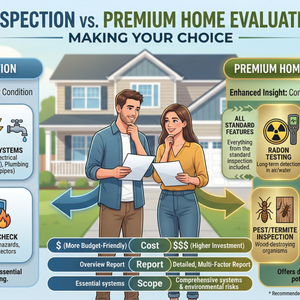
A practical guide for homebuyers in Fort Worth, Weatherford, Justin, and the greater DFW area
Picture this: You’ve just had an offer accepted on a home in Fort Worth. It’s the one — the right neighborhood, the right layout, the right price. You’re in your option period, and your real estate agent asks a question that suddenly makes the whole thing feel a little more complicated: “Do you want the standard inspection, or should we add some premium services?”
You pause. The standard inspection is cheaper. But what if it misses something? What if there’s a cracked sewer line under the yard, or mold hiding behind the walls, or a foundation issue that won’t show up until after closing? The premium package costs more — but how much more, and is it actually worth it for this specific home?
This is exactly the kind of decision that deserves a clear, honest answer — not a sales pitch. This guide breaks down what each package includes, what it costs, when each one makes sense, and how to choose the right option for your specific situation in the DFW market. By the end, you’ll have the clarity you need to make a confident, informed decision.
Key Takeaways
- A standard home inspection covers major systems visually and costs $300–$500 in DFW — it’s a solid baseline for newer homes in good condition.
- Premium packages bundle standard inspections with specialized services like thermal imaging, sewer scopes, mold screening, and foundation analysis, typically ranging from $600–$1,200+.
- Homes built before 1990 almost always benefit from premium add-ons — older plumbing, wiring, and foundations carry risks that visual inspection alone cannot detect.
- DFW added approximately 178,000 new residents in 2024, creating a competitive market where thorough inspections provide critical negotiation leverage.
- Skipping premium services on the wrong home can lead to repair bills of $3,000–$50,000+ — far exceeding the cost of the inspection itself.
- The right choice depends on the home’s age, condition, your budget, and your risk tolerance — not a one-size-fits-all answer.
Why Home Inspection Packages Matter in the 2026 DFW Market
The Dallas-Fort Worth metro isn’t slowing down. DFW added approximately 178,000 new residents from 2023 to 2024 alone, ranking as the third-fastest-growing metro in the entire country. Fort Worth officially crossed the 1 million resident threshold as of July 2024, and cities like Weatherford and Justin are growing at rates that would have seemed impossible a decade ago — Weatherford at nearly 4% annually, Justin at roughly 10% per year.
That growth creates a unique inspection landscape. You have brand-new construction going up in Tarrant County — which saw 6,579 new residential permits in 2025, a 65% year-over-year increase — sitting right alongside mid-century homes that have been through decades of Texas heat, drought, and storm cycles. The inspection needs for these two categories of homes are dramatically different.
Fort Worth’s median home price sits in the $340,000–$376,000 range in 2026. That’s a significant investment — one that deserves serious due diligence. And in a competitive market where option periods are tight and sellers sometimes receive multiple offers, the inspection window can feel uncomfortably short. Choosing the right inspection package from the start means you get the information you need before that window closes.
The team at Journey Home Inspections serves Fort Worth and surrounding areas across DFW, and they see firsthand how the right inspection package can make the difference between a confident purchase and a costly surprise. Understanding your options before you’re sitting in that option period is the best preparation you can do.
What Is a Standard Home Inspection?
A standard home inspection is a visual assessment of a home’s major systems and components conducted by a licensed inspector. In Texas, home inspectors are regulated by the Texas Real Estate Commission (TREC), which sets minimum standards for what must be evaluated and how findings must be reported. Every licensed inspector in Fort Worth, Weatherford, Justin, and across DFW operates under these standards.
The standard home inspection process typically takes two to three hours for a single-family home, depending on its size and complexity. After the inspection, you receive a detailed written report with photographs, descriptions of findings, and severity ratings for each issue identified. In DFW, standard inspections generally cost between $300 and $500, varying based on the home’s square footage and age.
It’s important to understand that “visual-only” doesn’t mean superficial. A skilled inspector examines hundreds of components and can identify significant issues that are visible to a trained eye. But the key limitation is exactly that — it’s limited to what can be seen. Hidden problems require specialized tools and testing to detect.
What Standard Inspections Cover
A standard inspection evaluates the following major systems and components:
- Structural integrity and foundation condition — visible cracks, settling, and signs of movement
- Roof condition, age, and estimated remaining lifespan — shingles, flashing, gutters, and drainage
- HVAC systems — heating, cooling, and ventilation equipment operation and condition
- Plumbing — water pressure, visible pipes, fixtures, water heater, and drainage
- Electrical panel and visible wiring — breaker condition, grounding, and safety concerns
- Interior and exterior condition — walls, ceilings, floors, windows, doors, siding, and trim
- Attic and crawl space — insulation, ventilation, and visible structural members
What Standard Inspections Don’t Cover
This is where buyers sometimes get caught off guard. A standard inspection does not include:
- Pest or termite inspections — these require a separate, licensed pest control professional
- Mold screening or air quality testing — mold hidden behind walls or in crawl spaces won’t be detected
- Sewer line condition — underground pipes require a camera scope to assess
- Radon testing — requires a dedicated 48-hour test with specialized equipment
- Lead paint or asbestos testing — these require laboratory analysis of samples
- Detailed foundation or structural engineering assessment — a standard inspection notes visible concerns but doesn’t provide engineering analysis
Understanding these gaps is not a criticism of standard inspections — it’s simply knowing what tool you’re using and whether it’s the right one for the job at hand. For many homes, a standard inspection is exactly what’s needed. For others, those gaps represent real financial risk.
Understanding Premium Home Evaluation Packages
A premium home evaluation package starts with everything a standard inspection includes — and then goes further. These packages bundle the baseline visual inspection with two to five specialized add-on services, chosen based on the home’s age, condition, and the buyer’s specific concerns. Think of it as a standard inspection with a targeted diagnostic layer added on top.
The premium inspection packages available for DFW homebuyers typically range from $600 to $1,200 or more, depending on which services are selected and the size of the home. That’s a meaningful investment — but it’s one that needs to be measured against what it can uncover, and what those discoveries could cost you if they’re missed.
Premium packages are particularly valuable for older homes, homes with visible signs of wear, new construction (where builder quality control can vary), and situations where a buyer wants the most complete picture possible before committing to a significant purchase. They’re also a powerful negotiation tool — detailed findings with technical documentation give you real leverage when asking sellers to address issues or adjust the price.
Common Premium Add-On Services Explained
Here’s what each major add-on service does and why it matters:
- Thermal imaging: An infrared camera detects temperature differences in walls, ceilings, and floors. This reveals hidden moisture intrusion, poor insulation, electrical hot spots, and air leaks that are completely invisible to the naked eye. It’s one of the most valuable tools available for identifying hidden problems before they become expensive repairs.
- Sewer scope: A camera is fed through the sewer line to visually inspect underground pipes for cracks, root intrusion, blockages, or collapse. This is especially critical for older homes with cast iron or clay pipes, but even newer homes can have installation defects that only a scope will catch.
- Mold screening: Air and surface samples are collected and sent to a laboratory for analysis. This detects mold growth in hidden areas — behind walls, in crawl spaces, or in attics — that visual inspection cannot identify. Results come with remediation recommendations if mold is found.
- Radon testing: A 48-hour passive or active test measures radon gas levels in the home. The EPA recommends testing in Texas, and elevated radon levels require mitigation systems to protect occupant health. This test is non-invasive and provides clear, actionable results.
- Foundation analysis: Goes beyond the visual assessment included in a standard inspection to provide a detailed evaluation of settling, cracks, drainage, and structural integrity. Often conducted with specialized equipment and sometimes involving a structural engineer’s assessment.
- Pest and termite inspection: A licensed pest control professional assesses for wood-destroying insects, including termites, carpenter ants, and wood-boring beetles. Texas’s climate makes termite activity a real concern, particularly in older homes.
Not sure which package fits your home? Journey Home Inspections can help you assess your specific needs and recommend the right services for your situation — no pressure, just honest guidance from a local team that knows DFW homes.
Talk to an Inspector About Your HomeWhen Should You Choose a Standard Inspection?
✓ A Standard Inspection May Be the Right Fit If…
Choosing a standard inspection isn’t settling — for the right home, it’s exactly the right tool. You’re likely well-served by a standard inspection if the home was built after 2010, shows no visible signs of damage or deferred maintenance, and has had major systems recently updated (roof, HVAC, plumbing). If the seller disclosures are thorough and clean, and the home has a predictable maintenance history, a standard inspection provides solid baseline due diligence.
First-time buyers on a tight budget who are purchasing a newer home in a stable neighborhood can feel confident that a standard inspection meets their needs. You can always add individual services later if the inspection reveals specific concerns — but for a well-maintained newer home, the baseline is often sufficient.
The key is honest self-assessment. If you’re confident in the home’s condition and the seller has been transparent, a standard inspection is a reasonable choice. If anything about the home gives you pause — its age, its condition, its history — that’s worth paying attention to.
Key Differences: Standard vs. Premium Home Inspections at a Glance
Sometimes the clearest way to understand a decision is to lay the options side by side. Here’s how standard and premium inspections compare across the dimensions that matter most to buyers:
| Feature | Standard Inspection | Premium Package |
|---|---|---|
| Inspection Method | Visual only | Visual + specialized testing |
| Duration | 2–3 hours | 4–6+ hours |
| Cost (DFW) | $300–$500 | $600–$1,200+ |
| Hidden Issues Detected | Limited to visible problems | Thermal, subsurface, air quality |
| Best For | Newer homes, good condition | Older homes, concerns, investment |
| Texas Compliance | Meets TREC minimum standards | Exceeds TREC standards |
| Report Detail | Written report with photos | Comprehensive with technical data |
| Negotiation Leverage | Moderate | Strong — documented evidence |
Cost Comparison Breakdown for DFW Buyers
If you’re building a premium package à la carte, here’s what individual add-ons typically cost in the DFW market:
- Standard inspection baseline: $300–$500
- Thermal imaging add-on: $100–$200
- Sewer scope add-on: $150–$300
- Mold screening add-on: $200–$400
- Radon testing add-on: $150–$250
- Foundation analysis add-on: $200–$500
- Pest/termite inspection: $75–$150
Many inspection companies — including Journey Home Inspections — offer bundle pricing that costs less than purchasing services individually. If you know you want two or three add-ons, asking about package pricing upfront can save you a meaningful amount. You can explore the full range of inspection services offered to understand what’s available and how they can be combined.
Red Flags That Warrant a Premium Inspection
⚠️ Consider a Premium Package If You Notice Any of These
Some warning signs should immediately prompt you to consider premium services, regardless of your initial budget. These aren’t reasons to walk away from a home — they’re reasons to look more carefully before you commit.
- The home was built before 1990 with original plumbing or electrical systems
- Visible water stains, discoloration on ceilings or walls, or musty odors anywhere in the home
- Foundation cracks, uneven floors, or doors and windows that don’t close properly
- Roof showing significant age, missing shingles, sagging areas, or damaged flashing
- Any mention of previous water damage, flooding, or mold remediation in the seller’s disclosure
- The home is located in an area with known soil movement, radon presence, or flood history
- Seller disclosure reveals deferred maintenance or a pattern of past repairs
These flags don’t necessarily mean the home has serious problems — but they do mean a visual-only inspection may not give you the full picture. The cost of adding targeted premium services in these situations is almost always worth it. You can review frequently asked questions about home inspections to better understand what inspectors look for and how they evaluate these concerns.
Why Older Homes in Fort Worth, Weatherford, and Justin Benefit from Premium Inspections
Here’s the local reality: while Fort Worth has seen substantial new construction — with about 40.86% of its housing stock built since 2000 — that still leaves nearly 60% of homes that are older, many of them significantly so. Weatherford’s numbers are similar, with about 44% built after 2000. That means the majority of homes in these markets carry the inspection challenges that come with age.
Older homes in Texas face a specific set of vulnerabilities. Cast iron sewer pipes — common in homes built before the 1980s — are prone to cracking, root intrusion, and eventual collapse. A sewer scope inspection can identify these issues before you close, potentially saving you $3,000 to $25,000 or more in repairs. Without a scope, you’re making a significant financial commitment without knowing the condition of one of the most expensive systems in the home.
Pre-1990 electrical systems may include outdated wiring types or panels that don’t meet current safety standards. Thermal imaging can detect hot spots in electrical panels and wiring that indicate fire risk — something no visual inspection can reliably identify. Similarly, aging HVAC systems and ductwork can show efficiency problems and air leakage that thermal imaging makes visible.
Foundation settling is a fact of life in Texas, where expansive clay soils shift dramatically with moisture changes. Older homes have had more time to develop foundation movement, and the consequences of missing a significant foundation issue can run into tens of thousands of dollars. A detailed foundation analysis goes beyond what a standard visual inspection can assess, providing documentation that helps you understand the severity of any concerns and plan accordingly.
For buyers considering home inspection services for older homes in Fort Worth and surrounding areas, premium add-ons aren’t an upsell — they’re a practical response to the real risks that come with purchasing an older home in a Texas climate.
New Construction Inspection Needs for Post-2010 Homes
New construction is booming across DFW — Tarrant County alone saw a 65% increase in new residential permits in 2025. But “new” doesn’t mean “problem-free.” Builders operate under intense production pressure, and construction defects are more common than many buyers realize.
Phase inspections — conducted at the pre-pour (foundation), pre-drywall (framing and systems), and final stages of construction — catch defects before finishes cover them permanently. Once drywall goes up, problems with framing, insulation, plumbing, and electrical are hidden from view. A pre-drywall inspection is one of the most valuable investments a new construction buyer can make.
Even after move-in, an 11-month warranty inspection — conducted before the builder’s one-year warranty expires — is an opportunity to document any defects that have emerged and require the builder to address them at no cost. Thermal imaging during this inspection can reveal improper insulation, air sealing failures, and moisture issues that developed during the first year of occupancy. And yes, even new sewer lines benefit from a scope — construction debris left in lines is a real issue that can cause blockages months after move-in.
If your home was built before 1990 or shows any signs of age and wear, a premium inspection can uncover issues that visual-only assessments simply miss — potentially saving you thousands in unexpected repairs after closing. The investment is small compared to what it protects.
Explore Inspection Services for Older HomesThe Hidden Costs of Skipping Premium Services
💡 Reframing the Cost: What You’re Really Paying For
A $600–$1,200 premium inspection feels like a significant expense in the moment. But consider what it’s protecting against. These are real repair costs that buyers in DFW have faced after purchasing homes where issues were missed:
- Sewer line damage: $3,000–$25,000+ to repair or replace underground pipes
- Mold remediation: $5,000–$10,000+ and significant disruption to occupants
- Foundation repairs: $10,000–$50,000+ for structural corrections
- Roof leak damage: $5,000–$15,000 in water damage, rot, and replacement costs
- Radon mitigation: $800–$2,500 for a mitigation system — but undetected long-term exposure carries serious health consequences
The math is straightforward. If a sewer scope costs $200 and reveals a cracked line that would cost $15,000 to replace, that $200 either saves you $15,000 in post-closing repairs or gives you the leverage to negotiate a price reduction or seller credit before closing. Either way, the inspection paid for itself many times over.
The harder calculation is the one where you skip the scope, close on the home, and discover the problem six months later when the line backs up. At that point, you own the problem entirely — no seller to negotiate with, no option period to walk away. That’s the real cost of skipping premium services on the wrong home.
It’s also worth noting that some of these issues — particularly foundation problems and mold — can affect a home’s resale value and your ability to sell it later. Buyers who discover these issues during their own inspection may walk away or demand significant concessions. Knowing about problems before you buy puts you in control. Discovering them after you own the home puts you on the defensive.
How to Choose the Right Inspection Package for Your Situation
There’s no universal answer to the standard vs. premium question — but there is a clear framework for thinking it through. Here’s how to approach the decision systematically, based on the factors that actually matter.
Start with the home’s age. This is the single most reliable predictor of inspection complexity. Homes built before 1990 almost always benefit from premium services — the systems are older, the materials are different, and the risk of hidden issues is meaningfully higher. Homes built after 2010 may be well-served by a standard inspection, though new construction phase inspections are a different category entirely.
Read the seller disclosures carefully. Any mention of past water damage, flooding, foundation movement, mold remediation, or major system repairs is a signal to look deeper. Sellers are required to disclose known issues in Texas, but they can only disclose what they know — and some issues have never been discovered. A premium inspection fills those gaps.
Assess the home’s visible condition. Walk through the home with fresh eyes. Are there water stains on ceilings? Does the floor feel uneven? Do doors stick or swing open on their own? Are there cracks in the brick or foundation? These visible signs are the inspection equivalent of a fever — they tell you something is worth investigating more closely.
Consider your budget and risk tolerance honestly. If you’re purchasing at the top of your budget and a major unexpected repair would create real financial hardship, the premium inspection is the more prudent choice. If you have financial reserves and the home is in excellent condition, the standard inspection may be sufficient. Only you can weigh these factors — but make the decision consciously, not by default.
Factor in your timeline. Premium inspections take longer — plan for four to six hours or more, plus lab turnaround time for mold and radon results. In a tight option period, you need to schedule early and account for the time to review findings and negotiate. This is especially important during DFW’s peak real estate season (February through July), when inspectors are in high demand.
Talk to your real estate agent. Experienced agents who know the local market can often tell you whether a particular home or neighborhood has a history of specific issues. They’ve seen inspection reports on comparable properties and can offer informed perspective on which add-ons are most relevant. You can also speak with a home inspection specialist about your specific home before booking — a brief conversation can help you identify which services make the most sense.
Decision Matrix: Standard vs. Premium vs. Hybrid
Use this as a quick reference when you’re making the call:
- Choose Standard if: The home is newer (post-2010), in good visible condition, seller disclosures are clean, you’re budget-conscious, and there are no specific concerns about the home’s systems.
- Choose Premium if: The home is older (pre-1990), shows signs of wear or deferred maintenance, has a history of repairs, or you’re making a significant investment and want the most complete picture possible.
- Choose a Hybrid Approach if: The home is mid-age (1990–2010) and you have one or two specific concerns — add a sewer scope and thermal imaging, for example, without purchasing the full premium package. This is often the most cost-effective strategy for homes in this age range.
- Always choose Premium if: The home is in a flood zone, has visible foundation concerns, shows evidence of water damage, or you’re purchasing as a rental investment where deferred maintenance could affect tenants.
Ready to move forward? Journey Home Inspections offers customized standard and premium packages tailored to your home’s age, condition, and your specific concerns. Get a quote based on your exact situation — no guesswork required.
View Inspection Packages and PricingWhat to Expect in a Premium Inspection Report
One of the most common questions buyers have about premium inspections is: what exactly do I get for the extra investment? The answer is a significantly more detailed and actionable document — one that goes well beyond a checklist of visible issues.
The foundation of any premium report is the comprehensive written inspection narrative — the same detailed findings, photographs, and severity ratings you’d receive from a standard inspection, but now supplemented with technical data from specialized testing. A thorough home inspection report should be something you can read, understand, and act on — not a document that leaves you with more questions than answers.
Here’s what premium report components typically include:
- Thermal imaging results with infrared photographs showing temperature anomalies in walls, ceilings, and electrical components. These images are annotated to explain what the temperature differences indicate — moisture intrusion, missing insulation, electrical hot spots, or air infiltration.
- Sewer scope video footage with a written analysis of line condition, including the location and severity of any defects found. If repairs are needed, the report will typically indicate whether the issue requires immediate attention or can be monitored.
- Mold screening results from laboratory analysis of air and surface samples, with a comparison to outdoor baseline levels. If mold is detected, the report includes remediation recommendations and guidance on next steps.
- Radon test results with the measured level in picocuries per liter (pCi/L), the EPA action level for comparison (4.0 pCi/L), and guidance on mitigation options if levels are elevated.
- Foundation analysis with measurements, documentation of any cracks or movement, drainage assessment, and recommendations — which may include referral to a structural engineer for further evaluation if warranted.
- Executive summary highlighting the most critical findings requiring immediate attention, separate from minor maintenance items. This helps you quickly identify what needs to be addressed before or after closing.
- Prioritized repair list that categorizes findings by urgency — safety concerns, major defects, and maintenance recommendations — giving you a clear roadmap for negotiations and post-purchase planning.
“A premium inspection report isn’t just a longer document — it’s a different kind of document. It gives you technical evidence, not just observations. That evidence is what turns inspection findings into negotiating power.”
The practical value of this level of detail becomes clear during negotiations. When you can show a seller a sewer scope video of a cracked pipe, or a thermal image of moisture behind a wall, you’re not asking them to take your word for it — you’re presenting documented evidence. That’s a fundamentally stronger negotiating position than a written observation that something “appeared to be” a concern.
Seasonal and Market Timing Considerations in DFW
The DFW real estate market has a distinct seasonal rhythm, and it affects inspection planning in ways that buyers sometimes don’t anticipate until they’re in the middle of a transaction.
Peak season in DFW runs roughly from February through July. This is when listing inventory increases, buyer competition intensifies, and inspection services are in highest demand. During this period, the most experienced inspectors can book out quickly — sometimes several days in advance. If you’re under contract on a home with a 10-day option period, waiting until day four or five to schedule your inspection is a real risk.
Premium inspections require even more advance planning during peak season. Some add-on services — particularly radon testing (which requires a 48-hour collection period) and mold screening (which involves lab turnaround time) — need to be factored into your timeline carefully. You want your complete results in hand with enough time to review them, consult with your agent, and negotiate before your option period expires. Schedule your inspection well in advance during peak season — ideally within 24 hours of going under contract.
The slower market period (August through December) offers more scheduling flexibility and a slightly less pressured environment for thorough inspections. Buyers purchasing during this window often have more time to evaluate findings and negotiate, which can work in their favor when premium inspection results reveal significant issues.
DFW’s ongoing population growth — with housing transactions projected to increase approximately 10% in 2026 — means that demand for inspection services is likely to remain elevated throughout the year. Building in extra lead time, regardless of season, is simply good planning. Most experts recommend having your inspection completed at least two to three days before your option period ends to allow adequate time for review and negotiation.
One more timing consideration: the rapid new construction boom across DFW means that phase inspections and 11-month warranty inspections are increasingly in demand. If you’re purchasing new construction in areas like Justin, Roanoke, or Argyle — where growth rates are particularly strong — planning your phase inspections well in advance of each construction milestone is essential. You can learn more about Journey Home Inspections’ approach to serving DFW buyers at every stage of the home purchase process.
FAQ: Standard vs. Premium Home Inspections
These are the questions we hear most often from buyers in Fort Worth, Weatherford, Justin, and across DFW when they’re weighing their inspection options. Honest answers, no fluff.
A standard inspection is genuinely sufficient for newer homes in good condition — it’s not a compromise, it’s the right tool for the right job. However, premium packages are highly recommended for homes built before 1990, homes with visible signs of wear or deferred maintenance, or any situation where you want the most complete picture possible before committing. The decision depends on the home’s age, its condition, the seller’s disclosure history, and your personal risk tolerance. If you’re uncertain, a brief conversation with a licensed inspector who knows the local market can help you decide — there’s no obligation to commit to a package before you’ve talked through your specific situation.
In 2026, premium packages in DFW typically range from $600 to $1,200 or more, depending on which add-on services you select and the size of the home. A standard inspection runs $300–$500 as the baseline, and individual add-ons cost between $100 and $500 each — thermal imaging ($100–$200), sewer scope ($150–$300), mold screening ($200–$400), radon testing ($150–$250), and foundation analysis ($200–$500). Many inspection companies offer bundle pricing that’s meaningfully less expensive than purchasing services individually, so it’s worth asking about package deals when you call. The cost should always be weighed against what each service protects you from discovering after closing.
Thermal imaging uses an infrared camera to detect temperature differences in walls, ceilings, and floors — differences that reveal hidden moisture intrusion, poor or missing insulation, electrical hot spots, and air leaks that are completely invisible to the naked eye. Think of it as seeing through walls without tearing them open. It’s especially valuable in older homes or homes with suspected water damage, because it can identify problems in their early stages — before they become expensive repairs or health hazards. The infrared images also serve as documented evidence, which is particularly useful when negotiating repairs with sellers or filing insurance claims.
For homes built before 1990, a sewer scope is one of the most valuable add-ons you can purchase. Older cast iron and clay pipes are prone to cracking, root intrusion, and blockages that can cost $3,000 to $25,000 or more to repair or replace — and none of these issues are visible during a standard inspection. Even newer homes benefit from a sewer scope, because construction debris left in lines during the building process can cause blockages months after move-in. If the home has any history of plumbing problems, slow drains, or sewer backups, a scope moves from “recommended” to “essential.” It’s a relatively inexpensive add-on that protects against one of the most expensive post-closing surprises a buyer can face.
A standard inspection typically takes two to three hours for a single-family home, while a premium inspection with multiple add-on services can take four to six hours or more on-site. Some services — like radon testing (48-hour collection period) and mold screening (lab analysis turnaround) — extend the timeline beyond the inspection day itself, so plan for results to come in over one to three additional days. This is why scheduling your inspection as early as possible in your option period is so important, especially during DFW’s peak real estate season from February through July. Building in adequate time to review findings and negotiate before your option period expires is essential.
Absolutely — and inspection findings are one of the most powerful negotiation tools available to buyers. If the inspection reveals significant issues, you can request that the seller make repairs before closing, offer a credit toward the cost of repairs, or reduce the purchase price to reflect the work needed. Premium inspections often provide considerably stronger negotiation leverage because they document issues with detailed reports, photographs, thermal images, and video footage — not just written observations. Having this documented evidence in hand before your option period ends gives you time to get contractor estimates, evaluate your options, and negotiate from a position of knowledge rather than uncertainty.
Still Weighing Your Options? Let’s Talk Through It.
Choosing between a standard and premium inspection doesn’t have to feel like a high-stakes guessing game. The right answer depends on your specific home, your timeline, and what matters most to you — and that’s exactly the kind of conversation our team is here to have.
Journey Home Inspections serves homebuyers throughout Fort Worth, Weatherford, Justin, Eagle Mountain, Roanoke, Southlake, Westlake, Argyle, Trophy Club, and the greater DFW area. We’re certified, locally experienced, and genuinely invested in helping you make the best decision for your investment.
Reach out to discuss your specific home, get a quote, or simply ask a question. There’s no pressure — just honest guidance from people who know DFW homes.
Connect with Journey Home InspectionsFort Worth, TX · Serving DFW, Weatherford, Justin, and surrounding communities