Weatherford, TX Home Inspections: Top Companies, Cost & Reviews
Updated for 2026 | Serving Parker County and the Greater DFW West Region
Here's a number worth sitting with before you sign anything: according to National Association of Realtors data, 30 to 40 percent of home purchases involve renegotiation of the purchase price or seller credits based on what an inspection turns up. That's not a rare edge case — that's nearly every other transaction. And in Weatherford, TX, where expansive clay soil affects an estimated 30 to 50 percent of homes and the area sees 3 to 5 significant hail events every single year, the stakes are even higher than the national average suggests.
Weatherford has grown over 40 percent since 2020. New subdivisions are rising alongside century-old homes in the city center. Buyers are committing to properties priced in the $390,000 to $400,000 range — and many of those homes are sitting on soil that shifts, swells, and contracts with every rain cycle and drought. Skipping a thorough inspection in this market isn't bold or efficient. It's a gamble that can cost you $5,000 to $50,000 or more in repairs you never saw coming.
This guide is here to change that. Whether you're a first-time buyer navigating your option period or a seasoned homeowner purchasing a second property in Parker County, you'll find everything you need to understand the Weatherford home inspection market — what it costs, who the top providers are, what the law requires, and how to use your inspection findings to protect your investment.
Key Takeaways
- Weatherford home inspections typically cost $375–$850+ depending on home size, with comprehensive packages running $800–$1,200 when add-ons are included.
- Expansive clay soil affects 30–50% of North Texas homes, making foundation evaluation one of the most critical components of any Weatherford inspection.
- All Texas home inspectors must be TREC-licensed — always verify credentials before hiring at the TREC license lookup tool.
- 30–40% of home purchases nationally involve renegotiation based on inspection findings — your inspection report is a negotiation tool, not just a checklist.
- Weatherford's peak inspection season (March–August) creates 3–7 day scheduling lead times; book your inspector immediately after going under contract.
- New construction homes in Weatherford still need phase inspections — builder errors and subcontractor mistakes are more common than most buyers expect.
- Termite/WDI, sewer scope, and septic inspections are not included in a standard Texas home inspection and must be ordered separately.
Why Home Inspections Matter in Weatherford's Fast-Growing Market
Weatherford isn't just growing — it's transforming. The city's population has surged over 40 percent since 2020, and Parker County now sits at an estimated 183,969 residents. That growth rate outpaces the broader DFW metro's roughly 1.4 percent annual increase, which means demand for housing is intense, inventory is competitive, and buyers are often moving fast. Fast, in real estate, can mean cutting corners — and the corner most commonly cut is the home inspection.
That's a dangerous shortcut in this market. With median home prices hovering around $390,000 to $400,000 and homeownership rates between 70 and 75 percent, buyers are making six-figure commitments in a region with some genuinely challenging property conditions. Understanding the full scope of what a home inspection covers is the first step toward protecting that investment.
The two biggest local risk factors are soil and sky. Weatherford sits on expansive clay soil — the same geology that affects much of North Texas — which swells dramatically when wet and contracts during drought. This natural cycle exerts tremendous pressure on foundations, causing movement, cracking, and settling that can range from cosmetic to catastrophic. Estimates suggest 30 to 50 percent of homes in the DFW and Parker County region show some signs of foundation movement.
Then there's the weather. Parker County sits squarely in what insurance professionals call "Hail Alley," experiencing an average of 3 to 5 significant hail events per year. Hail damage to roofing materials isn't always visible from the ground, but it compromises the integrity of shingles and flashing in ways that lead to leaks, water intrusion, and premature roof failure. A thorough roof inspection isn't optional here — it's essential.
Put these factors together and the math becomes clear. A standard home inspection in Weatherford costs $300 to $600. Unexpected foundation repairs can run $20,000 to $50,000 or more. Roof replacements typically cost $10,000 to $20,000. HVAC system failures can easily top $8,000 to $15,000. Skipping the inspection to save a few hundred dollars is one of the most expensive decisions a homebuyer can make.
Understanding the Weatherford Home Inspection Market
Parker County's economic profile is strong. Median household income in the county runs approximately $95,000 to $100,000, and the homeownership rate sits between 75 and 80 percent. These are buyers who are financially committed and who have a lot to lose if a home purchase goes sideways. That economic profile also means demand for high-quality, thorough inspections — not just the cheapest option available.
The Weatherford inspection market reflects the broader DFW pattern: peak season runs from March through August, when real estate transactions spike and inspector availability tightens considerably. During these months, expect scheduling lead times of 3 to 7 days. If you're working with a 7 to 10 day option period — which is standard in most Texas contracts — that means you need to call your inspector the same day you go under contract. Waiting even 48 hours can put you in a difficult position.
The housing stock in Weatherford is unusually diverse. The historic downtown core has homes dating back to the late 1800s and early 1900s, many of which have been updated piecemeal over the decades — which means layered systems, older wiring, and decades of deferred maintenance that require an experienced eye. Meanwhile, the outer rings of Parker County are seeing rapid new construction in master-planned communities, where the inspection concerns shift to proper installation, code compliance, and builder quality control.
Foundation type adds another layer of complexity. Slab foundations dominate newer construction, while pier-and-beam foundations are common in older homes and more rural properties. Each requires a different inspection approach, and not every inspector is equally proficient with both. In rural Parker County, many properties also rely on private wells and septic systems — components that fall entirely outside a standard home inspection and require specialized inspection services for unique property features like well water testing and septic system evaluation.
Texas has over 3,000 active TREC-licensed home inspectors statewide, but the concentration in any given area varies. The DFW west corridor — which includes Weatherford, Aledo, Springtown, and surrounding communities — is served by a mix of locally-based inspectors and Fort Worth-area inspectors who extend their service radius. Given the pace of residential growth, demand consistently runs hot, particularly during peak season.
Home Inspection Costs in Weatherford: What You'll Pay in 2026
Let's talk numbers. Weatherford home inspection pricing is tiered by square footage, which is the most common pricing model in the DFW market. Here's what you can expect to pay for a standard pre-purchase inspection in 2026:
| Home Size | Typical Price Range |
|---|---|
| Under 1,500 sq ft | $375 – $475 |
| 1,500 – 2,500 sq ft | $450 – $575 |
| 2,500 – 3,500 sq ft | $550 – $700 |
| 3,500+ sq ft | $675 – $850+ |
Weatherford prices are comparable to or slightly higher than the DFW metro average (roughly $450 to $600 for a mid-size home) and notably higher than the Texas statewide average of $400 to $550. This reflects the strong local demand, the prevalence of larger homes on bigger lots in Parker County, and the specialized expertise required to properly evaluate expansive clay soil conditions and storm damage.
Several factors can push your inspection cost higher. Older homes typically cost more to inspect because aging systems require more time and attention. Pier-and-beam foundations add cost because accessing and inspecting a crawl space takes longer than evaluating a slab. Homes with multiple HVAC units, pools, detached structures, or outbuildings all add inspection time. Properties significantly outside an inspector's base of operations may carry a travel surcharge. And if you need a rush inspection during peak season, expect to pay a premium for expedited scheduling.
Beyond the base inspection fee, most buyers in Weatherford should budget for at least a few add-on services. These are not included in a standard Texas inspection and must be ordered separately:
- Termite/WDI Inspection: $75 – $150
- Radon Testing: $150 – $250
- Sewer Scope (Main Line Camera): $175 – $350
- Septic System Inspection: $250 – $500
- Well Water Testing: $150 – $400
- Pool/Spa Inspection: $150 – $275
- Mold Testing: $300 – $700+
- Thermal Imaging: $100 – $200 (sometimes included in premium packages)
When you combine a standard inspection with the most commonly ordered add-ons — WDI, sewer scope, and potentially a pool inspection — the total for a typical Weatherford home runs $800 to $1,200. For rural properties with wells and septic systems, or homes requiring mold testing, that total can exceed $1,500. For detailed pricing information for your specific property, it's worth reaching out directly to get a quote tailored to your home's size, age, and features.
New Construction Inspection Packages in Weatherford
New construction inspections work differently than resale inspections. Rather than a single walkthrough at the end of a build, phase inspections are conducted at three critical points in the construction process: pre-pour (before the concrete foundation is poured), pre-drywall (before walls are closed up, when framing, plumbing rough-ins, and electrical are visible), and final (when the home is essentially complete). Each individual phase inspection typically costs $300 to $500.
Many Weatherford-area inspectors offer bundled new construction packages that cover all three phases for $900 to $1,500 or more. This is one of the smartest investments a new construction buyer can make — problems caught before the foundation is poured or walls are closed are dramatically cheaper to fix than issues discovered after move-in.
Ready to get a clear picture of what your Weatherford home inspection will cost? Journey Home Inspections provides transparent pricing and detailed quotes tailored to your property — no guesswork, no surprises.
Get Your Custom Inspection Quote💡 Don't Underestimate Hidden Costs
Most buyers discover they need more than just a basic inspection once they start the process. Budgeting $800–$1,200 upfront for a comprehensive package is far cheaper than discovering problems after closing. Sewer scope and septic inspections are especially critical in Weatherford's mix of urban and rural properties — these are the hidden issues that tend to generate the biggest post-closing surprises.
TREC Licensing and Regulatory Requirements for Texas Home Inspectors
Texas is one of the more rigorously regulated states when it comes to home inspector licensing, and that's genuinely good news for buyers. Every home inspector operating in Texas must hold an active license from the Texas Real Estate Commission (TREC). Hiring an unlicensed inspector isn't just risky — it leaves you without any regulatory recourse if something goes wrong.
You can verify any inspector's license status at https://www.trec.texas.gov/apps/license-holder-search/. The lookup tool shows the inspector's license status (active, inactive, expired, suspended), their license type, the original issue date and expiration date, and any public disciplinary actions or enforcement history. Take two minutes to run this check before you hire anyone — it's free and takes less time than reading this paragraph.
TREC licensing requires inspectors to complete 90 to 180 classroom hours of education, pass a rigorous state examination, and — for higher license levels — complete supervised field experience. Once licensed, inspectors must follow the Texas Standards of Practice (TREC SOP), codified in Texas Administrative Code Chapter 535, Subchapter R. These standards define the minimum requirements for a residential inspection, ensuring a consistent baseline of thoroughness and professionalism across the industry.
Understanding the TREC Standards of Practice for residential inspections helps you know exactly what your inspector is required to evaluate — and what falls outside the scope of a standard inspection. If you have questions about what's covered, reviewing the FAQ is a great starting point before your inspection day.
What's Included vs. Excluded in a Standard Texas Home Inspection
A standard TREC-compliant inspection covers visual inspection and operability testing of all major systems and components, including:
- Foundation and structural components
- Grading and drainage
- Roofing, roof structure, and attic
- Walls, ceilings, floors, doors, and windows
- Electrical systems (panels, wiring, outlets, fixtures)
- Plumbing systems (supply, drain, water heater)
- Heating and air conditioning systems
- Permanently installed appliances
- Fireplaces and chimneys
- Porches, balconies, decks, and attached garages
What's not included in a standard inspection: cosmetic imperfections, underground sewer or water lines (unless a sewer scope is ordered), environmental hazards like radon, mold, or asbestos, termites and wood-destroying insects, swimming pools and spas, sprinkler systems, detached structures other than garages, and code compliance verification. These require separate services with their own licensing requirements and must be ordered as add-ons.
If an inspector fails to meet TREC standards, you can file a formal complaint through TREC's website. TREC can impose fines, require additional education, suspend, or revoke a license. For monetary damages in a civil sense, you may also have recourse under the Texas Deceptive Trade Practices Act (DTPA).
When you're ready to schedule, make sure your inspector is TREC-licensed and has the local expertise to spot Weatherford-specific issues like foundation movement and storm damage. Journey Home Inspections brings both credentials and deep local knowledge to every Parker County inspection.
Learn About Our Credentials and ApproachTop Home Inspection Companies in Weatherford, TX: Compared and Reviewed
Finding the right inspector in Weatherford means looking beyond price alone. The best inspectors in this market combine TREC licensing with genuine local expertise — they know what expansive clay soil looks like when it's been moving for 20 years, they know how to spot hail damage on a 12-pitch roof, and they know the difference between a cosmetic crack and a structural red flag. The five companies below have strong reputations in the Parker County market and bring distinct strengths to the table.
Choosing the right inspector depends on your priorities: do you want the most educational experience possible? The fastest turnaround? The deepest structural expertise? The most flexible scheduling? Read through each profile and match it to what matters most for your purchase. You can also read verified customer reviews to get a sense of what working with each inspector is actually like.
Journey Home Inspections
Location: Fort Worth, TX (serving Weatherford and Parker County)
Specialization: Exceptionally thorough and detailed inspections with a strong emphasis on the educational experience for buyers.
What Customers Say: Clients consistently praise Journey Home Inspections for clear on-site explanations, comprehensive and easy-to-understand reports, and inspectors who take the time to answer every question — even the ones buyers didn't know they should be asking.
Notable Differentiator: Journey Home Inspections is known for empowering homebuyers with detailed knowledge and practical advice during the inspection process itself. You don't just get a report — you get a guided education in your home's condition and systems.
Best For: Buyers who want to deeply understand what they're buying, first-time homeowners who want to learn how their home's systems work, and anyone who values a thorough, unhurried inspection experience.
Texas Certified Home Inspections
Location: Weatherford, TX 76086
Specialization: Deep expertise in older Weatherford homes and rural property components, including well and septic systems.
What Customers Say: Clients commend Texas Certified Home Inspections for meticulous, professional service and a deep knowledge of local Weatherford construction. Reviewers particularly appreciate the ability to explain complex issues in plain language.
Notable Differentiator: Highly regarded for understanding the unique challenges of older Weatherford homes — the layered systems, the aging infrastructure, and the rural property components that many inspectors from outside the area miss.
Best For: Buyers of older historic homes in the Weatherford city center, or rural Parker County properties with wells and septic systems.
Prime One Home Inspections
Location: Fort Worth, TX 76179 (serving Weatherford)
Specialization: Prompt scheduling and an efficient yet thorough inspection process with fast report turnaround.
What Customers Say: Prime One receives high praise for detailed reports, a friendly and approachable demeanor, and a knack for making the inspection process feel manageable rather than stressful.
Notable Differentiator: Often recommended specifically for fast report delivery — critical when you're working against a tight option period and need findings in hand quickly to begin negotiations.
Best For: Buyers on tight timelines, competitive multiple-offer situations, or anyone who needs to move quickly through the inspection and negotiation process.
Eagle Eye Inspections LLC
Location: Weatherford, TX 76087
Specialization: Comprehensive inspections with particular expertise in foundation evaluation and structural integrity assessment.
What Customers Say: Eagle Eye is lauded for attention to detail — especially when it comes to foundation concerns. Clients appreciate the in-depth knowledge and willingness to thoroughly investigate any structural concerns that come up during the inspection.
Notable Differentiator: Strong local reputation for identifying subtle signs of expansive clay soil movement and foundation stress — the kind of early indicators that less experienced inspectors might overlook or underestimate.
Best For: Buyers with specific concerns about foundation integrity, or anyone purchasing an older home where soil movement has had decades to do its work.
ProSight Home Inspections
Location: Fort Worth, TX 76108 (serving Weatherford)
Specialization: Professionalism, responsiveness, and the ability to accommodate urgent scheduling requests.
What Customers Say: ProSight is consistently commended for clear, concise reports that prioritize critical findings and provide actionable recommendations — making it easy for buyers to understand what needs immediate attention versus what can wait.
Notable Differentiator: Valued for adaptability to tight real estate timelines and a reporting style that focuses on what matters most, helping buyers enter negotiations with a clear sense of priorities.
Best For: Buyers who need scheduling flexibility, clear prioritized findings, or a report format that translates easily into repair request conversations with sellers.
Common Defects Found in Weatherford Home Inspections
Knowing what inspectors commonly find in Weatherford homes helps you understand why certain add-on services are worth the money — and why local expertise matters more here than in markets with more forgiving soil and weather conditions. These aren't hypothetical risks. They're the issues that show up repeatedly in Parker County inspection reports.
Foundation issues top the list, affecting an estimated 30 to 50 percent of homes in the region. The severity ranges enormously — from hairline cracks in interior drywall that reflect normal seasonal movement to significant structural settlement requiring engineered repair. A specialized foundation and structural assessment from an inspector who understands North Texas soil conditions is invaluable for putting these findings in proper context.
Roofing damage affects 25 to 40 percent of homes inspected in the area. Hail damage is the primary culprit, and it's not always obvious from the ground. Granule loss, bruising on shingles, and damaged flashing can all compromise a roof's integrity without being visible without a proper inspection. Many homeowners have uncollected insurance claims sitting on their roofs — an inspector who identifies hail damage may actually save you money on a roof replacement you didn't know you were owed.
HVAC system failures and aging equipment show up in 20 to 35 percent of inspections. North Texas's extreme temperature swings — 100-plus degree summers and occasional hard freezes — put enormous stress on heating and cooling equipment. An aging system that's limping along may fail entirely within a year or two of purchase. Understanding your HVAC's condition is critical for budgeting. You can also review guidance on maintenance and your HVAC system to understand what proactive care looks like after you move in.
Plumbing leaks and issues appear in 15 to 25 percent of inspections. Water heater failures, corroded supply lines, slow drains, and improper venting are among the most common findings. In older homes, galvanized steel pipes may be nearing the end of their serviceable life. A sewer scope — which sends a camera through the main drain line — can reveal root intrusion, pipe deterioration, or bellying that a standard inspection can't catch.
Electrical hazards are found in 10 to 20 percent of inspections, with older homes carrying a higher risk. Outdated wiring types (aluminum branch circuit wiring, knob-and-tube), improper grounding, double-tapped breakers, and missing GFCI protection in wet areas are among the most common findings. These aren't cosmetic issues — they're safety concerns that need to be addressed.
Drainage and grading problems affect 15 to 25 percent of homes and are closely linked to foundation issues. When water pools against a foundation or flows toward the home rather than away from it, it accelerates the soil movement that causes foundation damage. Improving grading and drainage is often one of the most cost-effective ways to protect a foundation long-term.
And then there's deferred maintenance — the category that affects nearly 100 percent of homes inspected. Worn caulking, damaged weatherstripping, minor wood rot, aging paint, and small roof penetrations that haven't been properly sealed. These items aren't emergencies, but they accumulate, and they're useful negotiating points.
Why Expansive Clay Soil Is a Big Deal in Weatherford
Expansive clay soil behaves unlike most soil types. When it absorbs water — during heavy rains or after irrigation — it swells significantly. When it dries out during drought, it contracts and pulls away from foundations. This cycle of expansion and contraction exerts enormous lateral and vertical pressure on concrete slabs and pier-and-beam foundations alike.
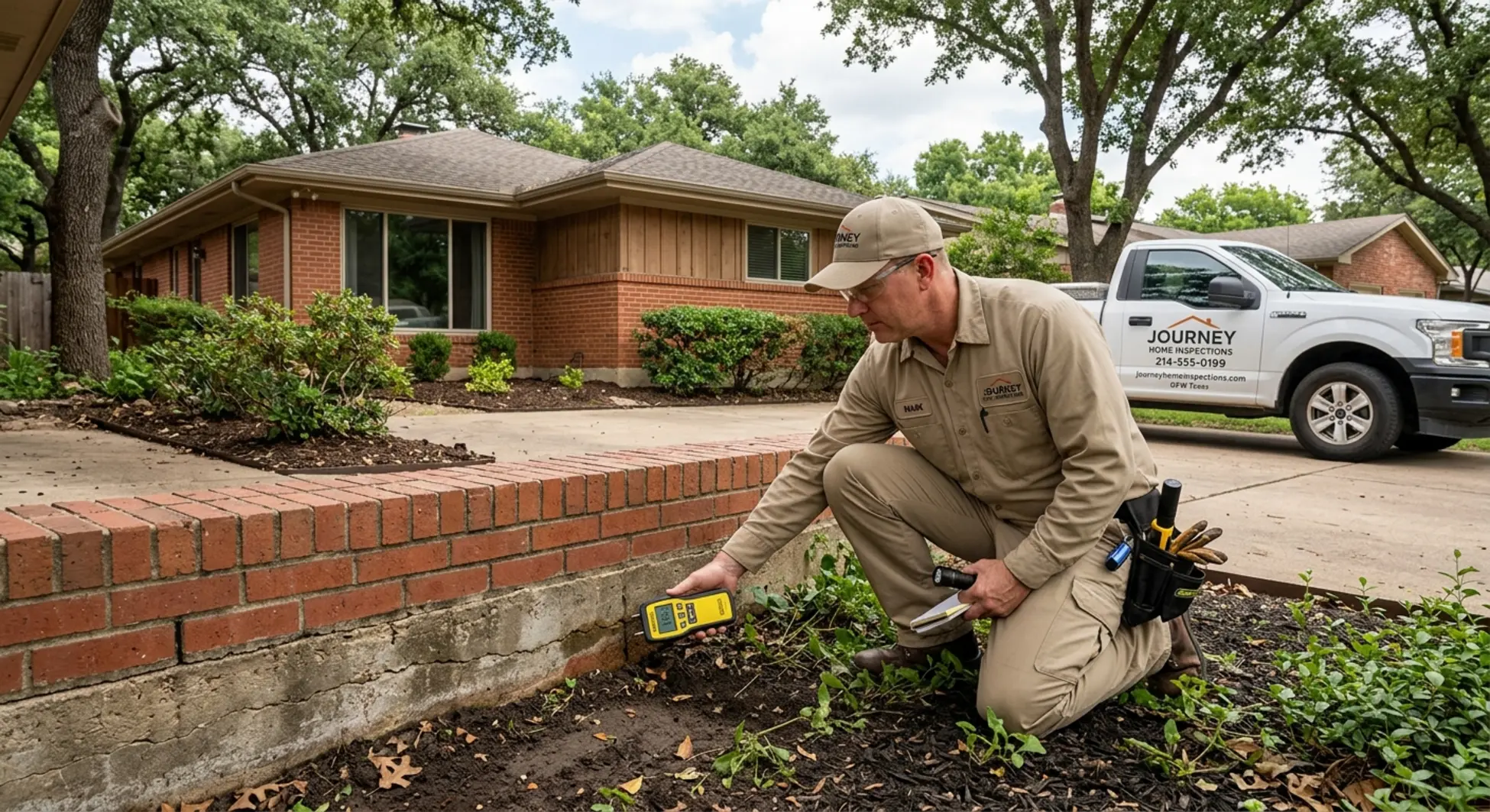
Over years and decades, this movement causes foundations to crack, shift, and settle unevenly. Interior doors that stick or won't latch, diagonal cracks running from window corners, gaps between walls and ceilings, and sloping floors are all potential indicators of foundation movement. The challenge is that not all of these signs indicate serious structural problems — some reflect normal seasonal movement that's been happening since the home was built.
This is exactly why local expertise matters. An inspector who has evaluated hundreds of Parker County homes understands the difference between the hairline crack that's been stable for 30 years and the fresh crack that indicates active movement. They know how to assess severity, when to recommend monitoring versus immediate repair, and when to call in a structural engineer for a more detailed evaluation.
"Proper grading, drainage, and foundation design are critical to minimizing expansive soil damage — and inspectors trained in North Texas conditions know exactly what to look for and how to assess severity."
⚠️ Foundation Issues Are Not Always Deal-Breakers
Minor foundation movement is extremely common in North Texas and does not automatically mean a home is unsafe or that you should walk away. What matters is the severity, the pattern of movement, and whether it's active or historic. Many foundation issues can be negotiated with the seller — a repair credit, a price reduction, or a warranty — rather than treated as automatic deal-killers. Understanding the difference between cosmetic cracking and structural failure is the key to making an informed, confident decision rather than a fear-based one.
What Happens After the Inspection: Negotiation and Next Steps
The inspection report lands in your inbox and it's 40 pages long. There are photos of things you've never seen before, terminology you don't recognize, and a list of deficiencies that ranges from "replace missing outlet cover plate" to "evidence of significant foundation movement." Now what?
First, breathe. A long inspection report doesn't mean a bad house — it means a thorough inspector. Every home, including brand-new construction, will have findings. What matters is understanding which findings are significant, which are routine maintenance, and which represent genuine negotiating leverage.
For significant defects — major foundation issues, roof damage requiring replacement, HVAC systems at end of life, electrical hazards — buyers have several options. You can request that the seller make specific repairs before closing. You can ask for a credit at closing (essentially a reduction in what you bring to the table, which you then use to fund repairs after purchase). Or you can renegotiate the purchase price downward to reflect the cost of repairs you'll handle yourself.
It's important to understand that in Texas, sellers are not legally obligated to fix anything found in an inspection. They can decline every repair request. If that happens, you have a choice: accept the property as-is, continue negotiating, or terminate the contract and receive your earnest money back — but only if you're still within your option period. This is why the option period timeline is so critical.
Your real estate agent plays a key role in this process. They can help you prioritize which findings to negotiate on (not everything is worth fighting for), obtain repair estimates from licensed contractors to support your requests, and facilitate the back-and-forth with the seller's agent. A detailed inspection report that documents all findings with photos and clear descriptions is your most powerful tool in this negotiation — it transforms your repair requests from opinions into documented evidence.
One practical tip: focus your negotiation on safety issues, major system failures, and items that would be difficult or expensive to address after closing. Cosmetic items and routine maintenance are generally not worth the negotiating capital. Save your leverage for the things that matter.
Your inspection report is your most powerful tool during negotiations. A detailed, well-documented report from an experienced inspector gives you the evidence you need to support repair requests or price adjustments — and that's exactly what Journey Home Inspections delivers for every Parker County buyer.
Schedule Your Weatherford Inspection🛡️ Your Option Period Is Your Protection Window
Most Texas contracts include a 7 to 10 day option period during which you can terminate for any reason and receive your earnest money back. Schedule your inspection immediately after going under contract — don't wait until day 6 of a 7-day option period. If major issues surface near the end of your window, you'll have almost no time to negotiate or make an informed decision. Delaying your inspection doesn't just create scheduling stress; it directly reduces your negotiating leverage and may force you into accepting the property as-is.
Home Inspection vs. Appraisal: Understanding the Difference When Buying in Weatherford
This is one of the most common points of confusion for first-time buyers, and it's worth clearing up directly: a home inspection and an appraisal are completely different services that serve completely different purposes. You need both, and neither replaces the other.
A home inspection is for your benefit as a buyer. It's a comprehensive evaluation of the home's physical condition — the structure, the systems, the components — conducted by a TREC-licensed inspector who is working for you. The goal is to identify defects, safety hazards, and maintenance issues so you can make an informed decision about the purchase and negotiate appropriately. A thorough inspection covers everything from the foundation to the roof and gives you a detailed picture of what you're actually buying.
An appraisal is for your lender's benefit. Its purpose is to determine the fair market value of the property to ensure the home is worth the amount being borrowed. An appraiser is not a home inspector — they're evaluating value, not condition. While appraisers do check for obvious safety and habitability issues (especially for FHA and VA loans, which have minimum property standards), their review is far less detailed and comprehensive than a dedicated home inspection.
This distinction matters particularly for VA and FHA buyers. Neither loan type technically requires a private home inspection — only an appraisal. But relying solely on the appraisal for condition assessment is a significant risk. An appraiser might note that the roof appears functional from the ground without identifying the hail damage that a roof-level inspection would catch. They might not flag the foundation cracking that an experienced inspector would evaluate in detail. A comprehensive home inspection that goes beyond appraisal requirements is one of the smartest investments any buyer can make, regardless of loan type.
Think of it this way: the appraisal protects the bank. The inspection protects you. In a market like Weatherford — where foundation issues, storm damage, and aging housing stock are genuine concerns — protecting yourself is non-negotiable.
If you're comparing inspection companies across the DFW area, it's also worth reviewing how different providers stack up — resources like a comparison of national inspection franchise pricing and reviews can help you understand what different service models offer and how local independent inspectors compare.
Frequently Asked Questions About Weatherford, TX Home Inspections
Should I use my realtor's recommended inspector or find my own in Weatherford?
Your realtor's recommendation is a reasonable starting point — they've likely worked with local inspectors and have firsthand knowledge of who produces thorough, useful reports. That said, you have the absolute right to choose any TREC-licensed inspector you prefer, and it's worth interviewing two or three before deciding. Look specifically for inspectors with demonstrated expertise in Weatherford's expansive clay soil conditions and storm damage patterns — these are the local variables that separate a good inspection from a great one. Check Google reviews, verify the TREC license, and trust your gut about who communicates clearly and takes the time to answer your questions.
What happens if the home inspection finds major problems in a Weatherford home?
Finding major defects doesn't automatically mean the deal is dead — it means you have information and options. You can request that the seller make specific repairs before closing, ask for a credit at closing to fund repairs yourself, or renegotiate the purchase price downward. If the seller refuses to address serious issues and you're still within your option period, you can terminate the contract and receive your earnest money back. Your real estate agent will help facilitate these negotiations and can obtain contractor estimates to support your requests. The inspection report itself is your documentation — the more detailed it is, the stronger your negotiating position.
Do I need a separate termite (WDI) inspection in Texas, or is it part of a regular home inspection?
A Wood Destroying Insect (WDI) inspection — commonly called a termite inspection — is a completely separate service in Texas and is not included in a standard home inspection. It must be performed by a licensed pest control applicator, which most home inspectors are not. Given Texas's warm climate and the prevalence of subterranean termites throughout the state, ordering a WDI inspection alongside your general home inspection is strongly recommended. Many lenders, particularly for FHA and VA loans, require it. Budget $75 to $150 for this add-on — it's one of the most cost-effective protections available.
Is a home inspection required for a VA or FHA loan in Weatherford, TX?
Technically, neither VA nor FHA loans require a private home inspection — both require an appraisal that includes minimum property standards, but an appraisal is not a substitute for a comprehensive inspection. The appraiser's review is focused on value, not condition, and is far less detailed than what a licensed home inspector provides. Even if your loan type doesn't mandate it, a private home inspection is one of the most important steps you can take to protect your investment. In a market like Weatherford, where foundation issues and storm damage are genuinely common, skipping the inspection because it's not technically required is a risk that rarely pays off.
Should I get a new construction home inspected in Weatherford, even if it's brand new?
Absolutely, yes — and this is not a close call. New homes can have significant defects resulting from builder errors, subcontractor mistakes, rushed timelines, and inadequate quality control. Phase inspections conducted at the pre-pour, pre-drywall, and final stages catch problems while they're still accessible and while the builder is still responsible for fixing them under warranty. Issues discovered after you move in are far more expensive and complicated to address. The $900 to $1,500 cost of a bundled new construction inspection package is a small price to pay for independent verification that your brand-new home was built correctly. Don't rely solely on the builder's own inspections — they have a financial interest in the outcome that you don't share.
What's the difference between a home inspection and an appraisal when buying a home in Weatherford?
A home inspection is conducted for your benefit as the buyer — its purpose is to assess the home's physical condition, identify defects and safety hazards, and give you a comprehensive understanding of what you're purchasing. An appraisal is conducted for your lender's benefit — its purpose is to determine the home's fair market value to ensure it's worth the loan amount. While appraisers do note obvious safety and habitability concerns, their review is not nearly as detailed or comprehensive as a dedicated home inspection. Both serve important but entirely different functions, and neither replaces the other. For a deeper dive into this comparison, you can also review how home inspections work in the broader Fort Worth market for additional context.
Get a Detailed Weatherford Home Inspection You Can Trust
Whether you're buying your first home in Weatherford or your fifth, a thorough inspection is what stands between you and a costly surprise. You deserve to walk into closing knowing exactly what you're buying — the good, the needs-attention, and the things to watch over time.
Journey Home Inspections combines TREC licensing, deep local expertise in Parker County properties, and a genuine commitment to educating homebuyers every step of the way. We don't just hand you a report — we walk you through your home so you understand it.
Schedule your inspection today and discover exactly what you're buying — with the confidence that comes from knowing you had a real expert in your corner.
Schedule Your Weatherford Home Inspection